
Neuromodulation: A Simple Guide to Nervous System Adaptation
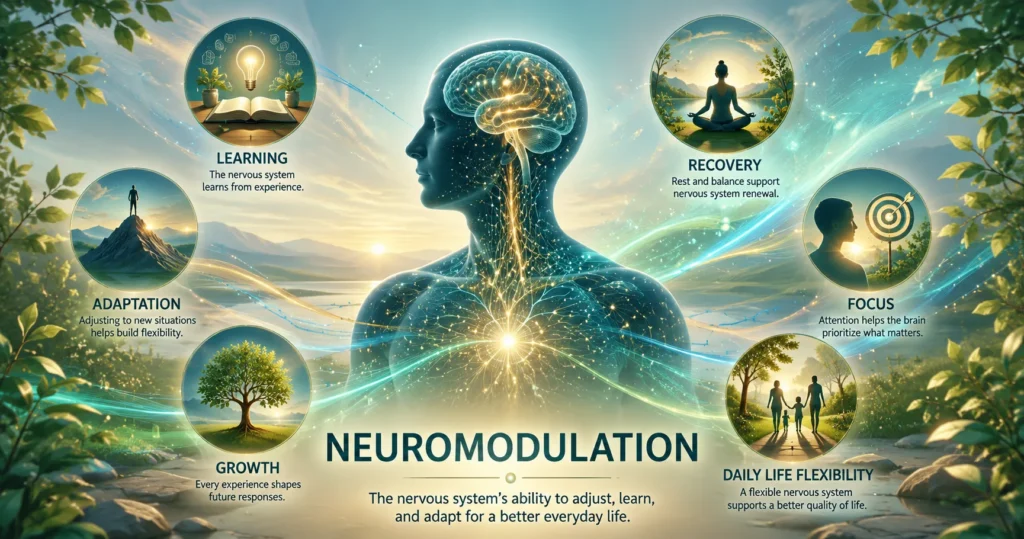
Neuromodulation means the way the nervous system adjusts. It helps the body and brain respond to daily life. Every day, people learn, move, think, rest, and react. Because life changes often, the nervous system also needs to change. This ability helps people adapt to new places, new habits, and new challenges. In simple terms, Neuromodulation helps the nervous system stay flexible instead of staying stuck in one response.
This page explains Neuromodulation in simple language. It does not give medical advice. Also, it does not explain treatment, devices, or diagnosis. Instead, it explains how the nervous system learns from experience. As a result, readers can better understand nervous system regulation, recovery, learning, and adaptation. This topic is useful because many people want to know why their body, focus, emotions, or stress response may change in different situations.
Neuromodulation also connects with Nervous System Regulation, Recovery Capacity and Nervous System Resilience, and Neuroplastic Adaptation. These topics help explain how the nervous system changes over time. Therefore, this page works as a simple starting point for learning how the nervous system adapts. Later, readers can explore related pages to understand stress, sleep, recovery, behavior change, and emotional regulation in more detail.
Quick Navigation
- What Is Neuromodulation?
- Plain Meaning / Glossary Box
- How Neuromodulation Works
- Initial Formation of Nervous System Responses
- Key Layers of Neuromodulation
- Sensory Layer of Neuromodulation
- Emotional Layer of Neuromodulation
- Cognitive Layer of Neuromodulation
- Behavioral Layer of Neuromodulation
- Recovery Layer of Neuromodulation
- Environmental Layer of Neuromodulation
- Real-Life Symptom Language Bridge
- Neuromodulation and Human Systems
- Neuromodulation Interactions
- Practical Daily-Life Examples
- Neuromodulation Visual Flow
- Why Neuromodulation Matters for Recovery
- Common Misunderstandings About Neuromodulation
- Related Condition Connections
- How Neuromodulation Connects With Other Nerve Health Pages
- Topic Cluster Placement
- Neuromodulation FAQ
- Continue Learning
- Sources / References
- Author / Editorial Trust Note
- Educational Trust Note
- Safety & Education Notice
What Is Neuromodulation?
Neuromodulation is the way the nervous system changes its response. It helps the brain and body decide what information matters most. For example, a sound may feel strong at first. Later, the same sound may fade into the background. The sound did not change. However, the nervous system changed how it handled that sound. This is one simple way to understand nervous system adjustment.
This process happens in many parts of life. A new job may feel hard at first. A new road may feel confusing. A new habit may take effort. However, practice and time often make these things easier. As a result, the nervous system learns from experience. Because of this learning, the same task may feel less stressful later.
In simple words, Neuromodulation helps people adapt. It supports learning, attention, recovery, and daily function. Therefore, it is an important part of nervous system flexibility. It does not mean the nervous system becomes perfect. Instead, it means the nervous system can keep adjusting as life changes.
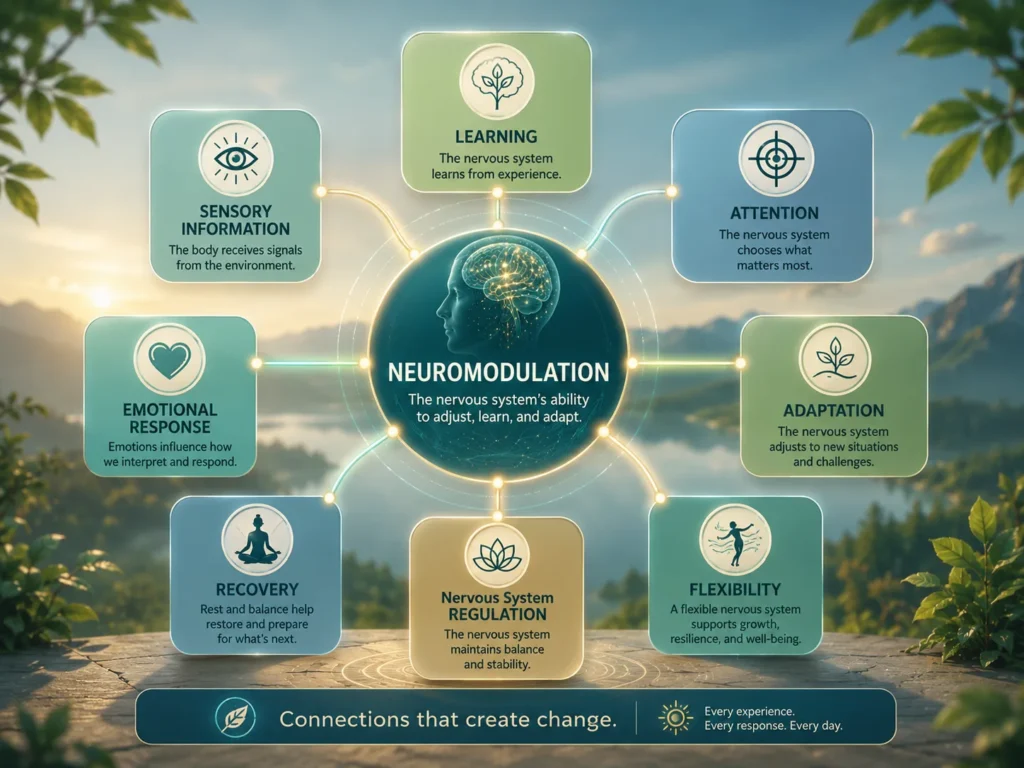
Plain Meaning / Glossary Box
Plain Meaning
Neuromodulation means nervous system adjustment. It is the way the nervous system changes how it responds to information. This information may include sounds, movement, emotions, stress, rest, learning, daily routines, and body sensations. Because the nervous system receives many signals each day, it must sort them and decide what deserves attention.
The nervous system does not stay the same forever. Instead, it learns from life. For example, repeated practice can make a task feel easier. Also, familiar places may feel less confusing over time. Because of this, Neuromodulation helps explain how people adjust to change. It is one reason people can learn, improve, and respond differently as time passes.
Simple Example
Imagine moving to a new city. At first, the roads feel confusing. You may need a map often. You may also feel unsure about where to go. However, after several weeks, the same roads feel easier. You may remember shortcuts, landmarks, and familiar turns. As a result, moving through the city takes less effort.
The city did not change. Instead, your nervous system learned the pattern. This is a simple example of Neuromodulation. The nervous system used repeated experience to reduce confusion and improve response. In the same way, people can adapt to new skills, new routines, and new environments over time.
Key Idea
The key idea is flexibility. The nervous system can learn and adjust. Because of this, people can build habits, learn skills, recover from stress, and adapt to new situations. This flexibility matters because life is not always predictable. New demands, new places, and new experiences appear often.
Neuromodulation does not mean everything becomes easy. However, it does mean the nervous system can change over time. Therefore, this topic helps explain learning, recovery, and resilience. It also helps readers understand why repeated experience, rest, and supportive routines may matter for long-term nervous system adaptation.
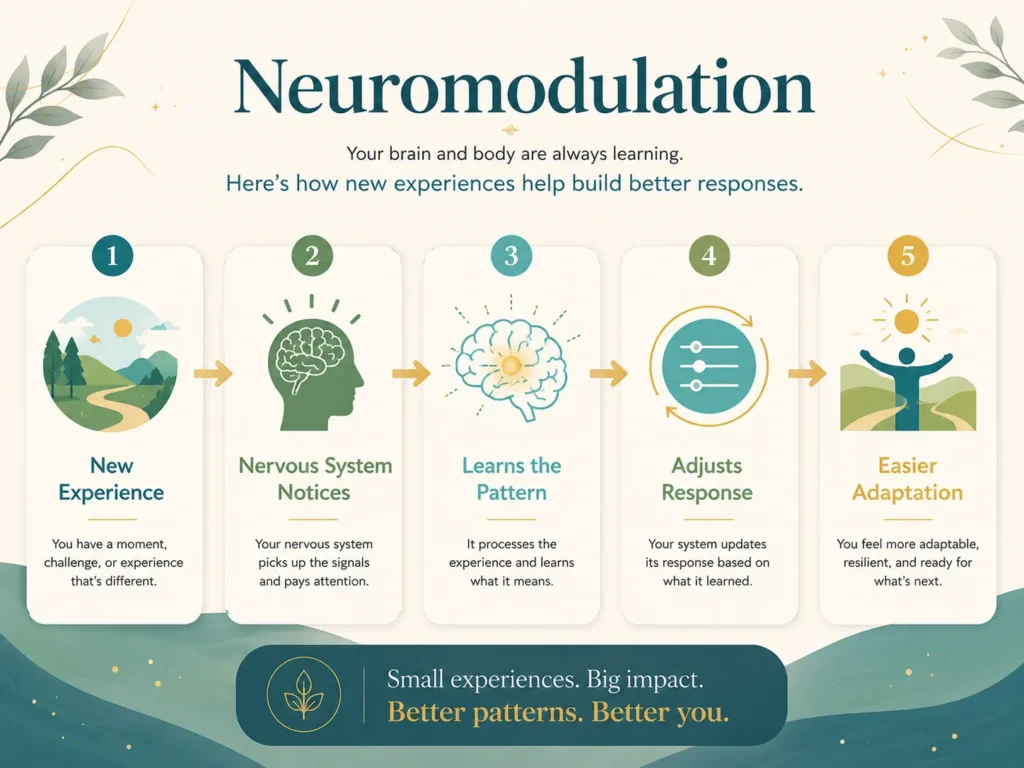
How Neuromodulation Works
Neuromodulation works by helping the nervous system sort information. Every day, the body receives many signals. These signals may come from sound, light, touch, movement, temperature, thoughts, emotions, and body feelings. However, the nervous system cannot focus on everything at once. So, it chooses what needs attention first.
For example, a loud sound may get attention quickly. Later, if the sound is not important, the nervous system may give it less focus. In this way, the nervous system saves energy and supports daily life. This does not mean the sound disappears. Instead, the brain and body change how strongly they respond to it.
Learning also shapes this process. When people repeat an action, the nervous system gets more familiar with it. As a result, the action may feel easier. Therefore, Neuromodulation helps explain why practice, rest, and daily experience matter. Over time, the nervous system uses past experience to guide future responses.
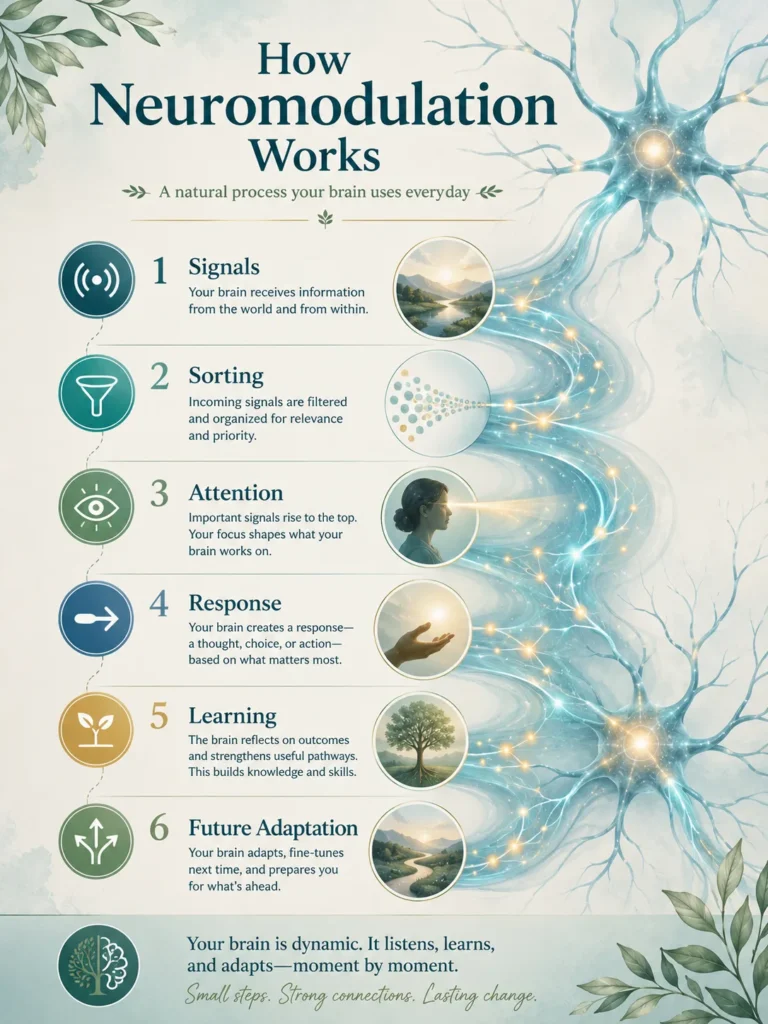
Initial Formation of Nervous System Responses
Nervous system responses often begin when a person meets a new situation. At first, the brain and body may need more attention to understand what is happening. For example, a new workplace, a new school, or a new routine may feel tiring at the beginning. This happens because the nervous system is still learning the pattern.
After repeated experience, the same situation may feel easier. The nervous system begins to recognize what is important and what is not. As a result, less effort may be needed. This is why familiar tasks often feel smoother than new tasks. Neuromodulation helps explain this change.
However, not every response changes at the same speed. Some patterns may shift quickly, while others may take more time. Therefore, adaptation should be understood as a gradual process. With learning, recovery, and repeated experience, the nervous system may build clearer response patterns over time.
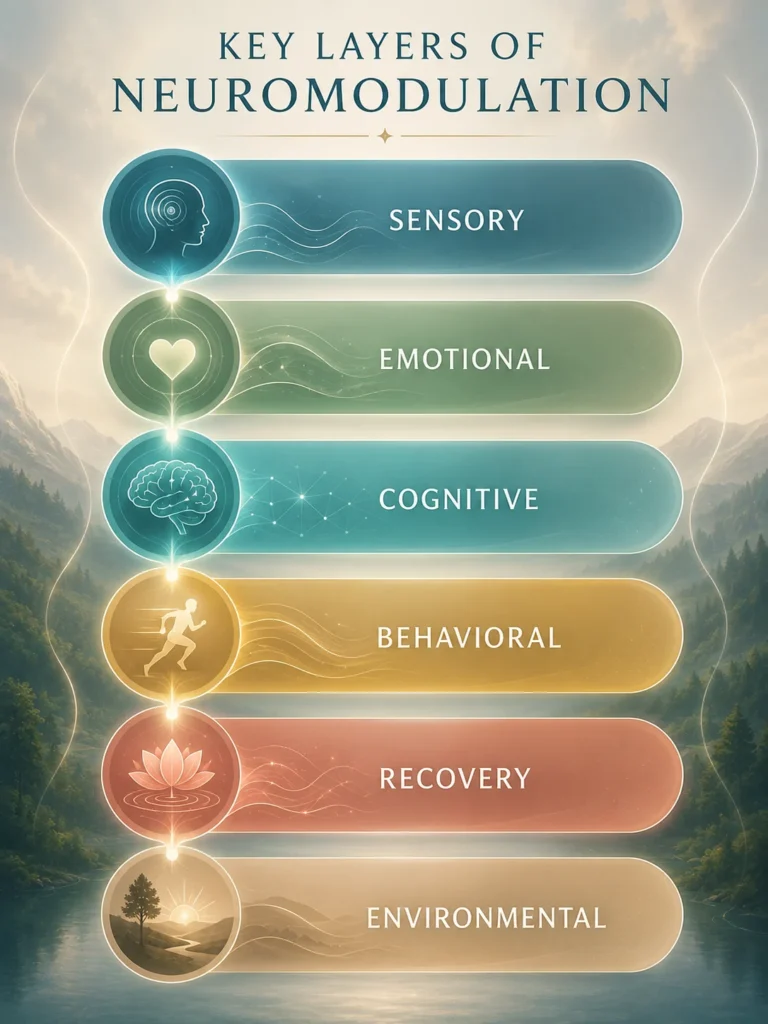
Key Layers of Neuromodulation
Neuromodulation has several layers. These layers work together every day. One layer helps people notice sounds, light, touch, and movement. Another layer helps people understand feelings. Other layers help with thinking, habits, rest, and the environment. Because these layers work together, the nervous system can adjust to daily life.
For example, a loud sound may catch attention. Then the person may feel alert. After that, they may decide what to do. Later, the nervous system may learn from that experience. As a result, the same sound may feel less strong next time. This is one simple way to understand Neuromodulation.
Sensory Layer of Neuromodulation
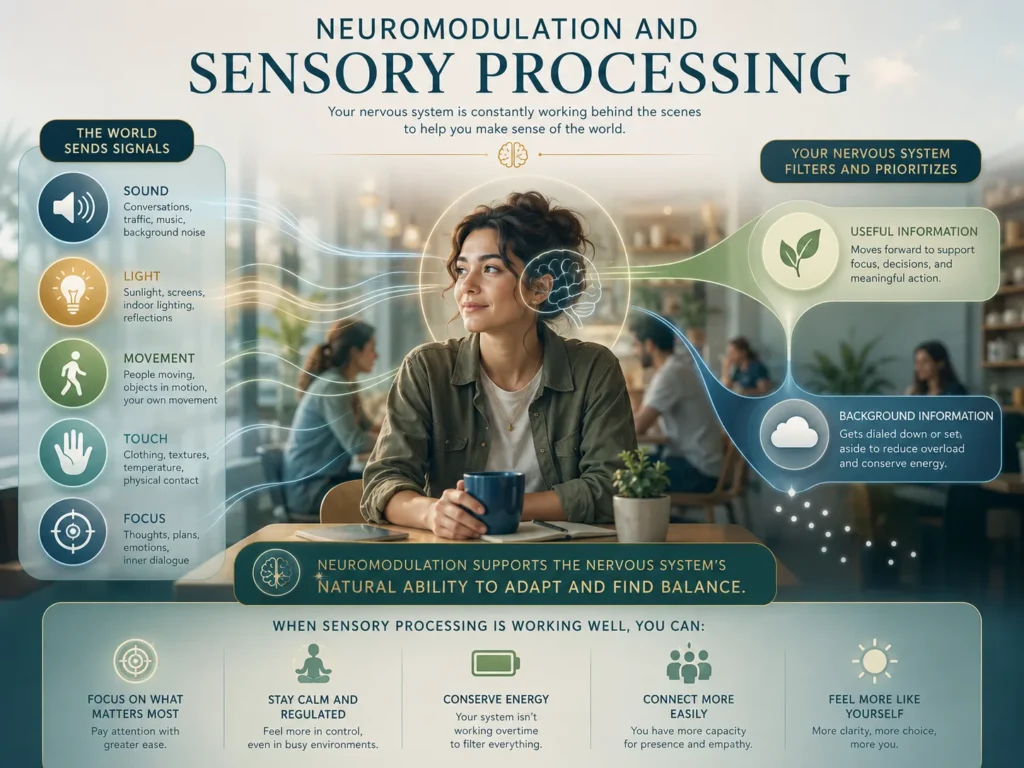
The sensory layer is about information from the world. This information may come from sound, light, touch, smell, taste, movement, or body position. Every day, the nervous system receives many signals. However, it cannot focus on all of them at once. So, it chooses what needs attention.
Imagine walking through a busy market. You may hear people talking, cars moving, and music playing. At the same time, you may look for one shop. Because of this, the nervous system filters information. It brings useful details forward and moves other details into the background.
This filtering helps daily life feel easier. Without it, the world could feel too busy. Therefore, the sensory layer helps people focus, respond, and adapt.
Why Sensory Processing Matters
Sensory processing matters because it is often the first step in response. Before a person can act, the nervous system must notice information. Then it must decide what that information means. After that, the person can respond.
A quiet room may help focus. A noisy room may make focus harder. Also, a familiar place may feel easier than a new place. Because of this, sensory information can affect attention, mood, and behavior. Therefore, this layer is important for nervous system regulation.
Emotional Layer of Neuromodulation
The emotional layer is about feelings. Feelings can affect attention, memory, learning, and choices. For example, an exciting event may be easy to remember. A stressful event may also stay in the mind for a long time. Because emotions show what matters, they can guide the nervous system.
Emotions are not only good or bad. Instead, they give information. Calm may help clear thinking. Fear may increase caution. Interest may support learning. As a result, emotions can shape how people respond to life.
Neuromodulation helps explain this connection. Feelings can change how the nervous system handles information. Then the nervous system may learn from that experience.
Emotional Awareness and Learning
Emotional awareness means noticing feelings. It also means slowing down enough to understand them. This can help people see patterns in daily life.
For example, one situation may increase confidence. Another may create tension. When people notice these patterns, they may understand themselves better. As a result, they may respond with more care.
This does not mean emotions disappear. Instead, people may learn how emotions affect attention and behavior. Therefore, emotional awareness can support learning and adaptation.
Emotional Flexibility
Emotional flexibility means people can feel different emotions and still keep moving through life. A person may feel stress, hope, worry, or calm at different times. This is normal.
The goal is not to remove every difficult feeling. Instead, the goal is to understand feelings and respond in a balanced way. Because life changes often, emotional flexibility can help people adapt. It may also support resilience over time.
Cognitive Layer of Neuromodulation
The cognitive layer is about thinking. It includes attention, memory, learning, focus, and meaning. The nervous system does not only receive information. It also tries to understand that information.
For example, two people may face the same event. One person may see it as a problem. Another may see it as a lesson. Because of this, thoughts can change how the nervous system responds.
Learning also matters. A new task may feel hard at first. Later, it may feel easier. This happens because the nervous system learns from practice. Therefore, the cognitive layer helps explain how thought and learning support adaptation.
Attention and Focus
Attention helps people choose what matters now. Without attention, the brain would have too much information to handle. So, focus acts like a filter.
Focus can change during the day. Sleep, stress, noise, emotions, and motivation can all affect it. For example, a quiet room may make reading easier. A busy place may make reading harder. Because of this, attention is an important part of Neuromodulation.
Learning Through Experience
People learn through experience. At first, a new skill may need full attention. Later, practice can make it easier. The task may not change, but the nervous system changes how it handles the task.
This is why repeated experience matters. It helps the nervous system build clearer patterns. As a result, people may feel more confident and less confused over time.
Behavioral Layer of Neuromodulation
The behavioral layer is about actions. It looks at what people do each day. This includes habits, choices, routines, and daily activities. These actions can shape how the nervous system learns.
For example, a new task may feel hard at first. However, practice can make it easier. The task may not change. Still, the nervous system learns the pattern. As a result, less effort may be needed later.
Daily habits work in the same way. Small actions can become familiar over time. Because of this, behavior is an important part of Neuromodulation.
Habits and Learning
Habits help the brain and body save effort. For example, most people do not think about every step when brushing their teeth. They have done it many times before. So, the action feels simple.
This happens through repetition. First, the nervous system learns the action. Then, practice makes the pattern stronger. As a result, the habit feels more natural. Therefore, habits show how Neuromodulation works in daily life.
Behavior and Adaptation
Life often asks people to adjust. A new job, new routine, or new responsibility may feel hard at first. However, repeated experience can make it easier.
Actions create experience. Experience creates learning. Then the nervous system uses that learning later. Because of this, behavior helps people adapt over time.
Recovery Layer of Neuromodulation
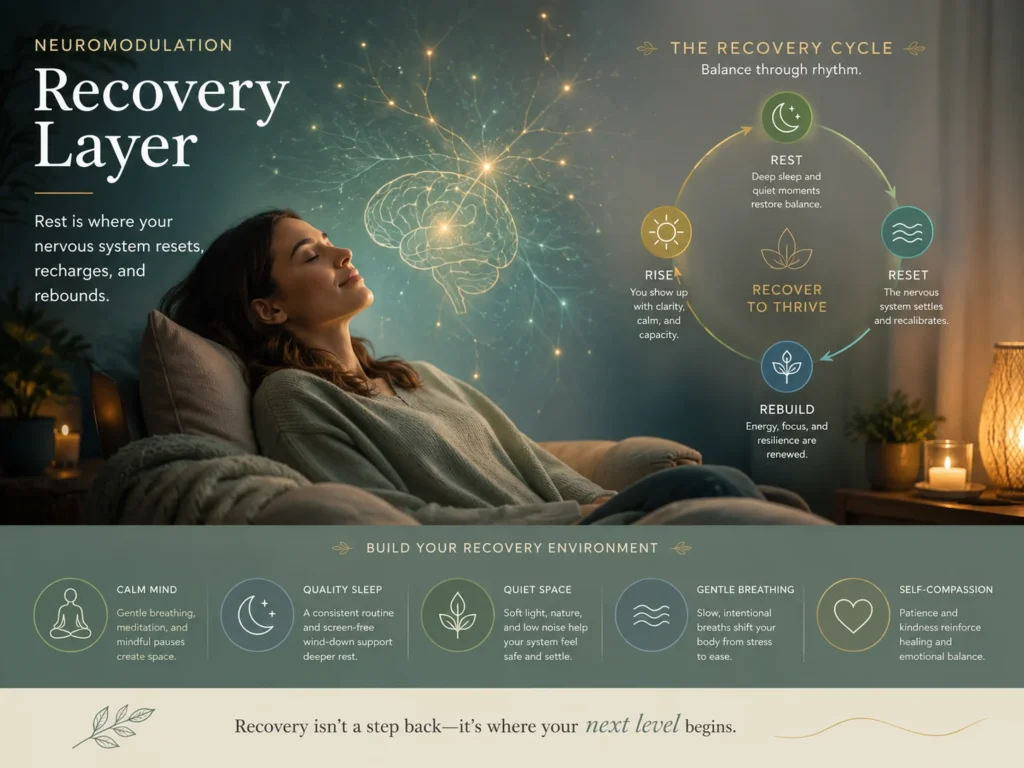
The recovery layer is about rest and balance. Activity is important. However, rest is also important. The nervous system needs time to recover after effort, stress, and learning.
Recovery can happen in many ways. Sleep is one example. Quiet time may help too. Supportive relationships may also help some people feel more steady. In addition, simple routines can support recovery.
Think about a phone battery. A phone can work for many hours. Still, it needs time to charge. The nervous system also needs time to restore energy.
Why Recovery Matters
Recovery helps the nervous system prepare for future demands. After rest, people may focus better. They may also feel more ready to learn or respond.
Recovery can affect mood, attention, learning, and resilience. Because of this, recovery is not separate from adaptation. It supports adaptation.
Recovery and Resilience
Resilience means adjusting after challenges. Recovery supports this process. It gives the nervous system time to restore energy and prepare for the next demand.
This does not mean all problems disappear. However, recovery may help people feel more flexible. Therefore, recovery and resilience often work together.
Environmental Layer of Neuromodulation
The environmental layer is about surroundings. This includes places, people, sounds, light, routines, and daily demands. The nervous system receives signals from the environment all day.
For example, a quiet room may feel different from a busy road. A familiar place may feel easier than a new place. These differences can affect focus, comfort, and attention.
However, people do not all respond the same way. One person may enjoy a busy space. Another may feel tired by it. Because of this, environment can affect each person differently.
Everyday Environmental Influences
Small things in the environment can matter. Noise, light, temperature, social contact, and workload can affect daily experience. These things may seem small. Still, they can change focus and energy.
Some people focus better in quiet places. Others like soft background sound. Because environments change, the nervous system keeps adjusting.
Environment and Adaptation
Adaptation often means learning how to respond to different places. A new workplace may feel hard at first. A new school or city may also need time.
Later, the same place may feel easier. The nervous system learns the pattern. As a result, less effort may be needed. This shows how Neuromodulation supports flexibility.
Real-Life Symptom Language Bridge
Many people search for Neuromodulation because they notice changes in focus, attention, stress response, or daily function. For example, someone may feel more sensitive to noise during busy days. Another person may need more time to adjust to a new routine.
These experiences can happen for many reasons. Therefore, Neuromodulation should not be used as the only explanation. Instead, it gives one simple way to understand nervous system change.
A person may say, “Busy places feel too much.” Another may say, “New situations take time for me.” These examples do not always mean something is wrong. They may show how the nervous system adapts.
This page is for learning only. It does not diagnose health problems. If symptoms are severe, unusual, worsening, or disruptive, professional help is important.
Neuromodulation and Human Systems
Neuromodulation is not only about nerves. It also connects with many parts of daily life. Thoughts, feelings, habits, relationships, recovery, and learning can all influence how the nervous system responds. Because of this, Neuromodulation fits naturally within Human Systems education.
For example, a person may learn a new skill. That learning can change confidence. Higher confidence may affect behavior. New behavior may create new experiences. Then the nervous system learns from those experiences. As a result, one change can influence many other areas of life.
This is why Human Systems topics often connect with each other. They do not work alone. Instead, they work together. Therefore, Neuromodulation is best understood as part of a larger picture rather than a single process.
Emotional Regulation and Neuromodulation
Emotional Regulation and Neuromodulation share a close connection. Emotions can affect attention, focus, learning, and decision-making. At the same time, the nervous system can influence how emotions are experienced.
For example, a calm person may find it easier to focus on a task. Meanwhile, a highly stressed person may struggle to concentrate. Because of this, emotional experiences can influence how information is processed.
Over time, people often learn more about their emotional patterns. This learning may help them respond in different ways. Therefore, Emotional Regulation and Neuromodulation often support one another.
Stress & Coping and Neuromodulation
Stress is a normal part of life. Everyone faces demands, challenges, and responsibilities. Because of this, the nervous system must adjust often.
Some situations may require extra attention. Others may require patience or problem-solving. As a result, coping skills can influence how people respond to daily demands.
Neuromodulation helps explain why responses may change over time. A situation that once felt difficult may feel easier later. This does not happen because life stops changing. Instead, the nervous system learns from experience.
Behavior Change and Neuromodulation
Behavior Change is closely linked to adaptation. New habits often begin with small actions. At first, these actions may require effort. However, repeated practice can make them feel more natural.
This pattern shows how learning works. The nervous system notices repeated actions and becomes more familiar with them. Because of this, behavior and Neuromodulation often develop together.
Over time, small changes may lead to larger changes. Therefore, behavior can play an important role in nervous system adaptation.
Motivation and Neuromodulation
Motivation helps guide attention and effort. People often spend more time on activities that feel important or meaningful. Because of this, motivation can influence learning and adaptation.
For example, a person who wants to learn a skill may practice more often. More practice creates more experience. Then the nervous system learns from that experience.
Motivation does not need to be perfect every day. Even small steps can support learning over time. Therefore, motivation and Neuromodulation often work together.
Meaning & Purpose and Neuromodulation
Meaning and purpose can shape daily choices. People often give more attention to activities that match their values and goals. Because of this, personal meaning may influence behavior, learning, and adaptation.
For example, someone may work hard on a project that feels important. Another person may spend time helping family or supporting a community. These activities often feel meaningful because they connect with personal values.
As a result, meaning and purpose may influence where attention and effort are directed. This connection helps show how Neuromodulation extends beyond simple nervous system responses.
Neuromodulation Interactions
Neuromodulation involves many interactions. Thoughts affect emotions. Emotions affect behavior. Behavior affects learning. Learning affects future responses. Because of this, adaptation often develops through many connected processes.
For example, a new experience may create a strong memory. That memory may influence future choices. Those choices may create new experiences. Then the cycle continues.
This does not mean every experience changes the nervous system in a major way. However, it does show that many small experiences can work together over time. Therefore, Neuromodulation is best viewed as an ongoing process.
Learning and Experience
Learning happens through experience. A person may learn from success. They may also learn from mistakes. In both cases, the nervous system gains information.
Over time, these experiences build patterns. Some patterns support confidence. Others support skill development. Because of this, learning remains one of the most important parts of Neuromodulation.
Recovery and Adaptation
Adaptation requires both activity and recovery. Learning often happens during action. Recovery often helps the nervous system restore resources afterward.
Think about exercise. Activity creates demand. Recovery helps the body prepare for future activity. A similar idea applies to nervous system adaptation.
Because of this balance, recovery and adaptation often support one another.
Practical Daily-Life Examples
Neuromodulation can sound complex. However, people experience it every day. Real-life examples often make the topic easier to understand.
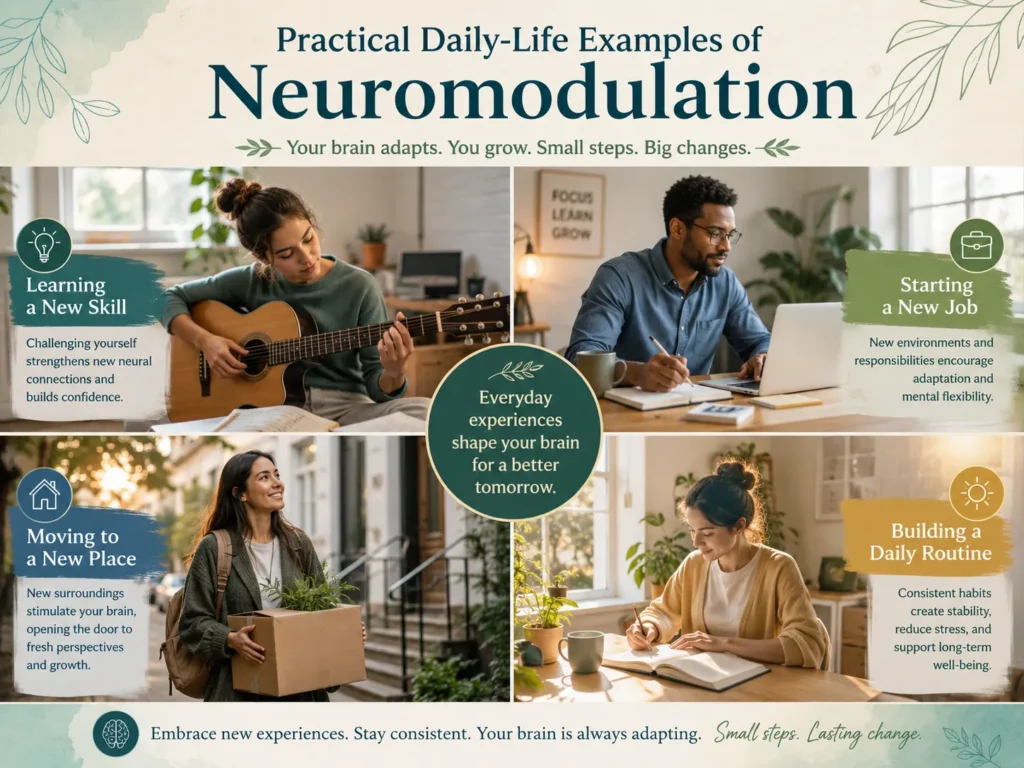
Learning a New Skill
A new skill usually feels difficult at first. A person learning a language may forget words. Someone learning a musical instrument may make mistakes. However, practice often improves performance.
The skill becomes easier because the nervous system learns. As a result, confidence and efficiency may increase over time.
Starting a New Job
A new job often requires extra attention. New people, new rules, and new tasks may feel overwhelming at first. However, familiarity usually develops with time.
After several weeks or months, many tasks may feel easier. The nervous system has learned the environment. Therefore, less effort may be needed.
Moving to a New Place
Moving to a new city or neighborhood often requires adjustment. Roads, buildings, and routines may feel unfamiliar in the beginning.
Later, navigation often becomes easier. Familiarity grows through experience. This simple example helps show how Neuromodulation supports adaptation.
Building a Daily Routine
Daily routines often begin with effort. People may need reminders to follow a new schedule. However, repetition can make the routine feel more natural.
Over time, the nervous system becomes familiar with the pattern. As a result, the routine may require less attention and effort.
Neuromodulation Visual Flow
Neuromodulation is easier to understand when it is viewed as a step-by-step process. Every day, people receive information from the world around them. Then the nervous system sorts that information and decides what deserves attention. After that, learning, emotions, thoughts, and behavior all play a role in shaping the response.
The process does not stop there. New experiences create new learning. Then that learning may influence future responses. Because of this, Neuromodulation works as an ongoing cycle rather than a one-time event. The nervous system keeps adjusting as life changes.
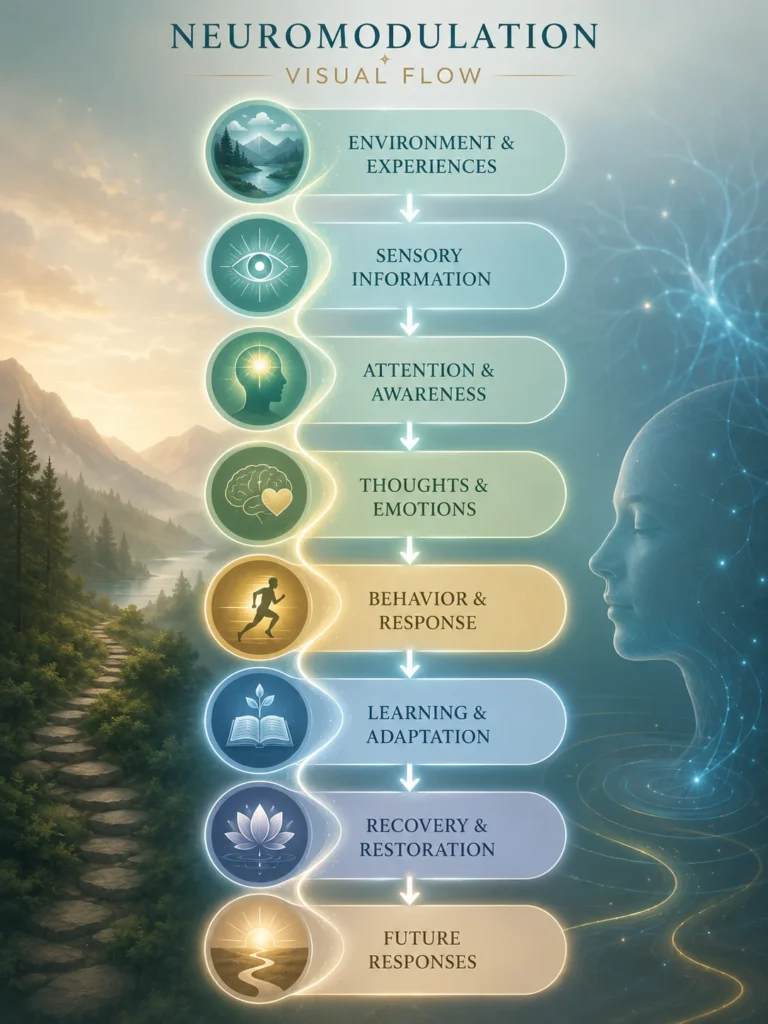
Environment and Experiences
↓
Sensory Information
↓
Attention and Awareness
↓
Thoughts and Emotions
↓
Behavior and Response
↓
Learning and Adaptation
↓
Recovery and Restoration
↓
Future Responses
This simple flow helps show how different parts of Neuromodulation connect. Each step can influence the next step. Therefore, adaptation develops through many small experiences over time.
Why Neuromodulation Matters for Recovery
Recovery is not only about rest. It is also about adaptation. People often think recovery means returning to normal after a challenge. However, recovery may also involve learning, adjustment, and growth.
For example, a person may need time to adjust after a stressful period. Another person may need time to learn a new routine. In both cases, the nervous system is working to adapt. Because of this, Neuromodulation plays an important role in recovery.
Recovery also supports future learning. When the nervous system has time to restore resources, it may be better prepared for future demands. Therefore, recovery and adaptation often support one another.
Recovery Supports Learning
Learning takes energy. Focus takes energy. Adaptation takes energy. Because of this, recovery matters.
Sleep is one example. Rest periods are another example. Quiet time may help as well. These recovery periods give the nervous system time to process information and prepare for future demands.
As a result, recovery is not separate from Neuromodulation. Instead, it is one of the processes that helps adaptation continue over time.
Recovery Supports Flexibility
Flexibility is one of the main ideas behind Neuromodulation. A flexible nervous system can adjust to changing situations more easily than a rigid one.
Recovery helps support this flexibility. Without recovery, adaptation may become more difficult. Therefore, rest and restoration remain important parts of nervous system function.
Common Misunderstandings About Neuromodulation
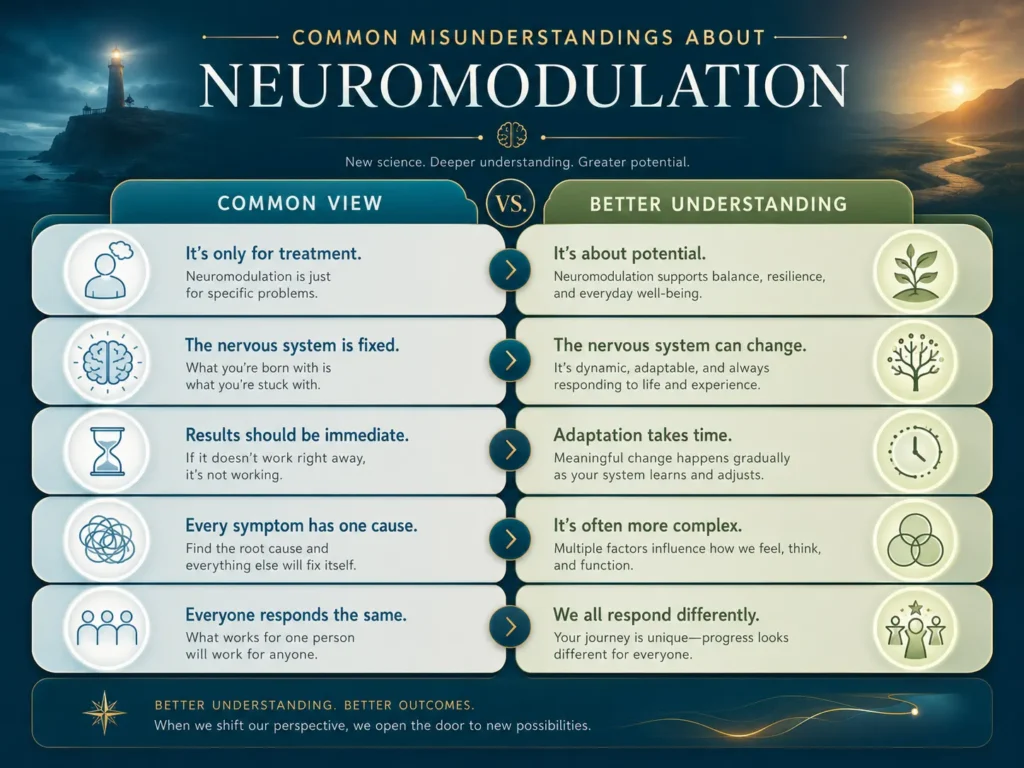
Neuromodulation is often misunderstood because the word sounds technical. As a result, people sometimes assume it refers only to medical devices or specialized treatments. However, the broader idea is much simpler.
In this educational context, Neuromodulation refers to how the nervous system adjusts, learns, and adapts. Therefore, it can be understood as a natural part of everyday life.
Misunderstanding 1: Neuromodulation Means Treatment
Many people hear the word and immediately think about medical procedures. However, Neuromodulation can also describe normal nervous system adaptation.
This page focuses on the educational meaning. It explains how the nervous system learns from experience and adjusts to daily life.
Misunderstanding 2: The Nervous System Never Changes
Some people believe the nervous system stays the same throughout life. However, learning happens throughout life. New experiences continue to shape future responses.
Because of this, the nervous system can adapt over time. Neuromodulation helps explain how that adaptation happens.
Misunderstanding 3: Adaptation Happens Overnight
Adaptation usually takes time. Most changes develop through repeated experience. Practice, learning, recovery, and familiarity often play important roles.
For example, learning a new skill may take weeks or months. Therefore, adaptation is often gradual rather than instant.
Misunderstanding 4: Neuromodulation Explains Every Symptom
Symptoms can have many causes. Therefore, Neuromodulation should not be used as the only explanation for health concerns.
Instead, it should be viewed as an educational topic that helps explain how nervous systems adapt and respond to experience.
Misunderstanding 5: One Response Fits Everyone
People are different. Experiences are different. Environments are different. Because of this, nervous system responses may vary from person to person.
What feels easy for one person may feel difficult for another. Therefore, adaptation should always be viewed within the context of individual experience.
Related Condition Connections
Some readers explore Neuromodulation while learning about nerve-related conditions. Others discover the topic while researching recovery, adaptation, or nervous system function. Because of this, Neuromodulation may connect with several educational condition pages.
These connections do not mean Neuromodulation causes a condition. They also do not mean a condition can be explained by Neuromodulation alone. Instead, they help readers understand how nervous system adaptation may fit into a larger learning framework.
Related educational condition pages include:
Each condition has its own causes, risk factors, and health considerations. Therefore, readers should view these pages as separate educational resources.
Why These Connections Matter
People often learn best when topics are connected. For example, someone reading about nerve function may also want to understand adaptation. Another reader may start with a condition page and later explore recovery topics.
These connections help build a broader understanding of nerve health education. As a result, readers can see how different topics relate to one another while still remaining separate subjects.
How Neuromodulation Connects With Other Nerve Health Pages
Neuromodulation does not stand alone. Instead, it connects with many other topics across the Heal Your Nerves Naturally learning system. This is because adaptation affects many parts of life. Learning, recovery, emotions, habits, sleep, and daily routines can all influence how the nervous system responds.
For example, Nervous System Regulation helps explain how the body and brain respond to changing situations. Neuroplastic Adaptation explores how learning can shape nervous system pathways over time. Meanwhile, Recovery Capacity and Nervous System Resilience focuses on restoration and flexibility after periods of demand.
These topics are connected because they all involve adaptation. However, each page looks at adaptation from a different angle. As a result, readers can build a broader understanding of how the nervous system works.
Human Systems Connections
Neuromodulation also connects with Human Systems topics. For example, Emotional Regulation explores how feelings affect daily life. Stress & Coping looks at how people respond to challenges. Likewise, Behavior Change explains how habits and actions develop over time.
Although these topics are different, they often influence one another. Therefore, learning about Neuromodulation can make other Human Systems topics easier to understand.
Recovery and Learning Connections
Recovery topics also connect closely with Neuromodulation. Sleep, rest, recovery cycles, and resilience all influence adaptation. Because of this, many readers explore these topics together.
For example, learning often happens during activity. Recovery helps support that learning afterward. Therefore, adaptation usually depends on both effort and recovery rather than either one alone.
Topic Cluster Placement
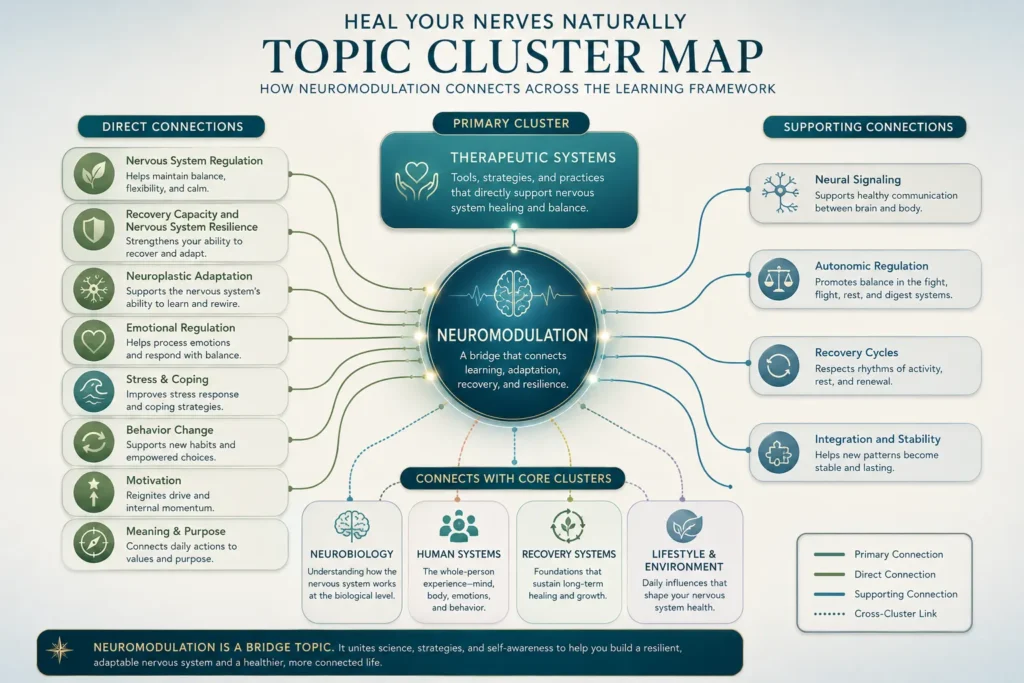
Within the Heal Your Nerves Naturally learning framework, Neuromodulation belongs primarily within Therapeutic Systems. However, it also connects with Neurobiology, Human Systems, and Recovery Systems.
Primary Cluster:
Direct Connections:
• Recovery Capacity and Nervous System Resilience
Supporting Connections:
Because of these links, Neuromodulation acts as a bridge topic. It helps connect learning, adaptation, recovery, and resilience into one larger educational framework.
Neuromodulation FAQ
What is Neuromodulation in simple terms?
Neuromodulation is the way the nervous system adjusts and adapts. It helps people learn from experience, respond to change, and handle daily demands.
Why is Neuromodulation important?
It helps explain how people learn new skills, adapt to new situations, and build familiarity over time. Without adaptation, daily life would be much harder.
Does Neuromodulation happen throughout life?
Yes. The nervous system continues learning and adjusting throughout life. Because of this, adaptation can continue for many years.
Is Neuromodulation the same as Nervous System Regulation?
The two topics are related, but they are not exactly the same. Nervous System Regulation focuses on balance and response. Neuromodulation focuses on adjustment and adaptation.
Can learning affect Neuromodulation?
Yes. Learning is one of the main drivers of adaptation. Every experience provides information that may influence future responses.
Does sleep connect with Neuromodulation?
Yes. Sleep supports recovery, learning, and restoration. Because of this, sleep plays an important role in adaptation.
Can daily habits influence Neuromodulation?
Yes. Repeated actions create repeated experiences. Over time, these experiences may shape learning and adaptation.
Does Neuromodulation explain every symptom?
No. Symptoms can have many causes. Therefore, Neuromodulation should not be used as the only explanation for health concerns.
Why does adaptation take time?
The nervous system often learns through repeated experience. Because of this, many changes develop gradually rather than instantly.
Can environments affect Neuromodulation?
Yes. Noise, light, social interaction, routines, and surroundings may all influence how the nervous system responds.
Is Neuromodulation a medical treatment?
This page discusses Neuromodulation as an educational concept. It focuses on adaptation and learning rather than medical treatment.
How does Neuromodulation relate to resilience?
Adaptation and resilience are closely connected. A nervous system that can adjust to change may support long-term flexibility and recovery.
Continue Learning
To continue exploring related topics, consider reading:
• Recovery Capacity and Nervous System Resilience
Together, these topics help explain how learning, adaptation, recovery, and resilience work across many areas of life.
Sources / References
Recommended educational resources:
• National Institute of Neurological Disorders and Stroke (NINDS)
• National Institutes of Health (NIH)
• National Center for Biotechnology Information (NCBI)
• American Psychological Association (APA)
• Centers for Disease Control and Prevention (CDC)
Readers are encouraged to review multiple trusted educational sources when learning about nervous system function, adaptation, and recovery.
Author / Editorial Trust Note
This page was created as part of the Heal Your Nerves Naturally educational platform. The goal is to provide clear, balanced, and easy-to-understand information about nervous system adaptation and recovery.
Content is written for education. It is designed to help readers understand complex topics without using unnecessary technical language.
Educational Trust Note
Neuromodulation is studied across neuroscience, psychology, rehabilitation, and human performance fields. Because the topic is complex, educational explanations often simplify scientific details.
This page focuses on practical understanding. The goal is to help readers build knowledge rather than provide medical advice or clinical guidance.
Safety & Education Notice
This page is for educational purposes only. It does not diagnose, treat, cure, or prevent any medical condition.
Symptoms such as severe pain, major weakness, loss of function, unusual sensory changes, worsening symptoms, or significant emotional distress should be evaluated by qualified healthcare professionals.
Neuromodulation should be viewed as an educational concept that helps explain adaptation, learning, flexibility, and recovery within the nervous system.