
Load Management: Balancing Demand, Capacity, and Recovery
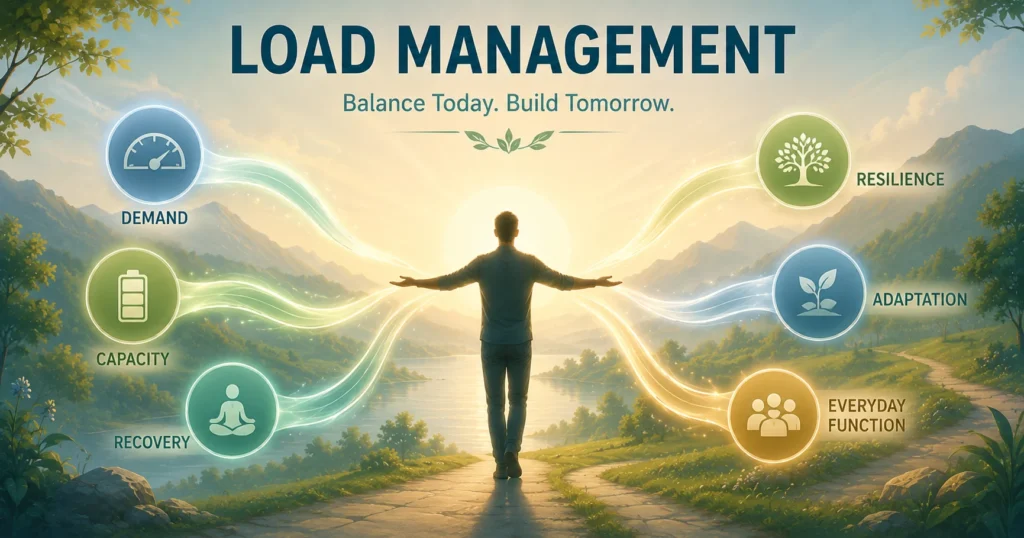
Load Management means balancing what life asks from a person with what that person can handle. Every day brings different demands. Work, learning, family needs, movement, stress, decisions, and routines can all use energy and attention. Because of this, Load Management helps explain how people manage daily life.
Demand and Capacity
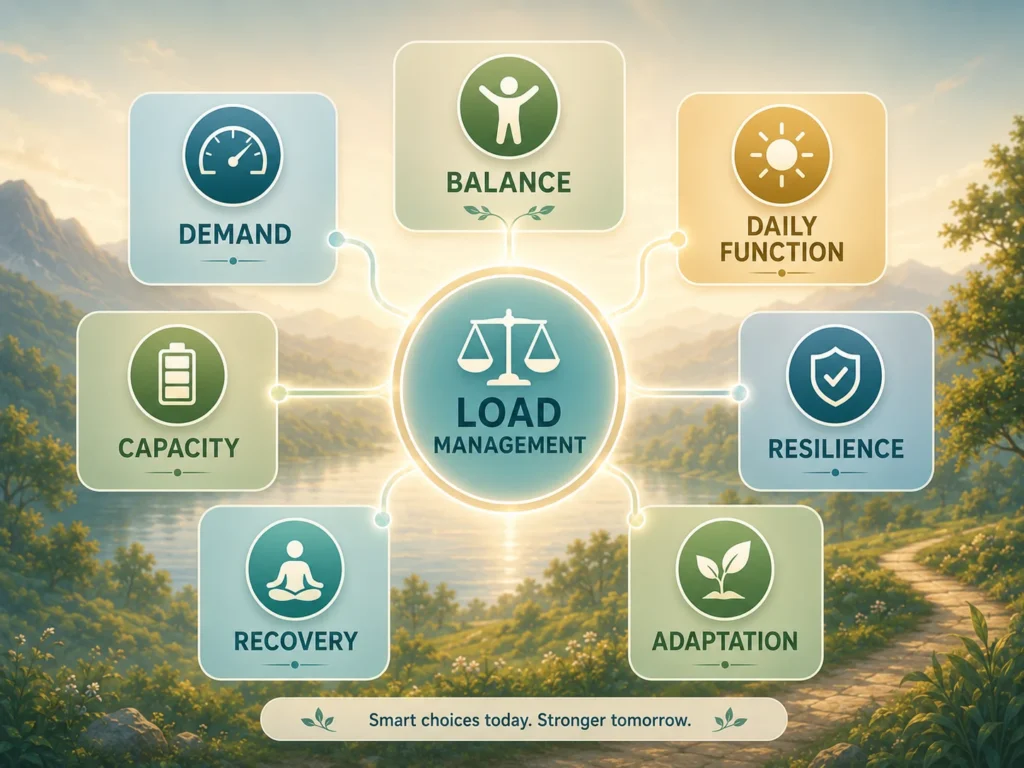
Demand means what a situation asks from the mind or body. Capacity means the amount of energy, focus, time, skill, and recovery available at that moment. When demand and capacity feel balanced, daily life may feel easier to manage. However, when demand stays higher than capacity for too long, life may feel harder.
This idea can apply to many areas. A long workday creates demand. Learning a new skill creates demand too. Even emotional stress can add load. Therefore, Load Management looks at the full picture, not only one activity.
Load Management Is About Balance
Load Management is not about avoiding all challenges. Instead, it is about finding a better balance between effort and recovery. Sometimes people need to use more effort. At other times, they may need more rest, planning, or support.
For example, a busy week may require more recovery time later. A new routine may need a slower start. A difficult task may need better planning. As a result, Load Management helps people understand when to continue, adjust, or recover.
Why Load Management Matters
Daily demands can add up. Small tasks, repeated stress, long hours, and constant decisions may create a larger load over time. Therefore, people may not always feel the effect from one event. Instead, the effect may build gradually.
Load Management helps readers understand this process. It explains how demand, capacity, recovery, and adaptation work together. This can make daily patterns easier to notice and understand.
Load Management in the HYN Framework
Within the Heal Your Nerves Naturally educational framework, Load Management connects with Recovery Engineering, Adaptation Engineering, Feedback Systems, Healing Sequencing, Protocol Design, Recovery Capacity and Resilience, and Neuromodulation.
Together, these topics explain how people respond to changing demands, learn from experience, recover after effort, and adapt over time.
Main Idea
The main idea is simple. Demands create load. Capacity affects what can be handled. Recovery helps restore resources. Adaptation helps future responses improve.
Because these parts work together, Load Management can help explain learning, resilience, recovery, and everyday function in a clear and practical way.
Quick Navigation
- What Is Load Management?
- Plain Meaning / Glossary Box
- How Load Management Works
- Key Layers of Load Management
- Demand Layer of Load Management
- Capacity Layer of Load Management
- Recovery Layer of Load Management
- Adaptation Layer of Load Management
- Balance Layer of Load Management
- Real-Life Symptom Language Bridge
- Load Management and Human Systems
- Load Management Interactions
- Practical Daily-Life Examples
- Load Management Visual Flow
- Why Load Management Matters
- Common Misunderstandings About Load Management
- Related Condition Connections
- How Load Management Connects With Other Nerve Health Pages
- Topic Cluster Placement
- Load Management FAQ
- Continue Learning
- Sources / References
- Author / Editorial Trust Note
- Educational Trust Note
- Safety & Education Notice
Plain Meaning / Glossary Box
Plain Meaning
Load Management means balancing what life asks from a person with what that person can handle at the moment. Every day brings demands. Work, learning, family needs, movement, relationships, routines, and decisions all use energy and attention.
Because of this, every person carries some level of daily load. Some load feels light. Other load feels heavier. Therefore, Load Management helps explain why certain days feel easy and other days feel harder.
Demand and Capacity
Demand means what a situation asks from you. Capacity means what you can currently handle. Capacity may include energy, focus, time, emotional strength, skills, experience, and recovery ability.
When demand and capacity feel balanced, daily life may feel more manageable. However, when demand stays higher than capacity for too long, even simple tasks may feel harder. As a result, Load Management looks at both sides together.
Recovery and Adaptation
Recovery helps restore resources after effort. For example, sleep, rest, calm time, enjoyable activities, reflection, and supportive relationships may help restore capacity.
Adaptation means learning and adjusting over time. A demand that feels difficult today may feel easier later because of experience, practice, and better understanding. Therefore, adaptation can help future capacity improve gradually.
Why This Matters
Load Management is useful because it looks at the whole picture. It does not only ask, “How much demand exists?” It also asks, “How much capacity is available?” and “Is recovery helping restore resources?”
As a result, Load Management helps explain daily function, resilience, learning, recovery, and long-term adjustment in a simple way.
Simple Definitions
Demand = What life asks from you.
Capacity = What you can currently handle.
Recovery = How used resources are restored.
Adaptation = How future capacity may improve through learning and experience.
Load Management = Balancing demand, capacity, recovery, and adaptation.
A Simple Example
Imagine carrying a backpack during a long walk. The weight inside the backpack is demand. Your strength and energy are capacity. Taking breaks is recovery. Becoming stronger over time is adaptation.
In everyday life, Load Management works in a similar way. Demands create load. Capacity helps manage that load. Recovery restores resources. Adaptation helps future responses improve.
What Is Load Management?
Load Management is a way to understand how much demand a person is carrying and how much capacity they have to handle it. In simple words, it helps explain the balance between effort and available resources.
Daily life creates many kinds of load. Some load comes from physical activity, such as walking, working, exercising, or completing household tasks. However, load is not only physical. Thinking, learning, planning, making decisions, managing emotions, handling relationships, and dealing with change can also create load.
Because of this, Load Management looks at the whole picture. It does not focus on one task alone. Instead, it asks how different demands work together during the day.
Load Is Different for Everyone
Every person experiences load in a different way. One person may handle a busy day with ease. Another person may find the same day very demanding. This does not mean one person is better than the other. Instead, it shows that capacity can be different.
Capacity may depend on sleep, recovery, experience, stress level, support, skills, health, and daily routine. Therefore, the same demand can feel different from person to person. It can also feel different for the same person on different days.
Load Management Is About Balance
Load Management is not about avoiding all effort. It is also not about removing every challenge from life. Challenges can help people learn, grow, and adapt.
Instead, Load Management focuses on balance. It helps readers understand when demands are reasonable, when recovery may be needed, and when adjustment may help. As a result, it becomes easier to understand why some periods feel manageable and others feel harder.
The Main Purpose
The main purpose of Load Management is to understand how demand, capacity, recovery, and adaptation work together.
Demand creates load. Capacity helps manage that load. Recovery restores used resources. Adaptation helps future responses improve over time.
Therefore, Load Management can be viewed as a practical learning framework. It helps explain how people respond to daily responsibilities, recover after effort, learn from experience, and gradually adapt to changing life demands.
How Load Management Works
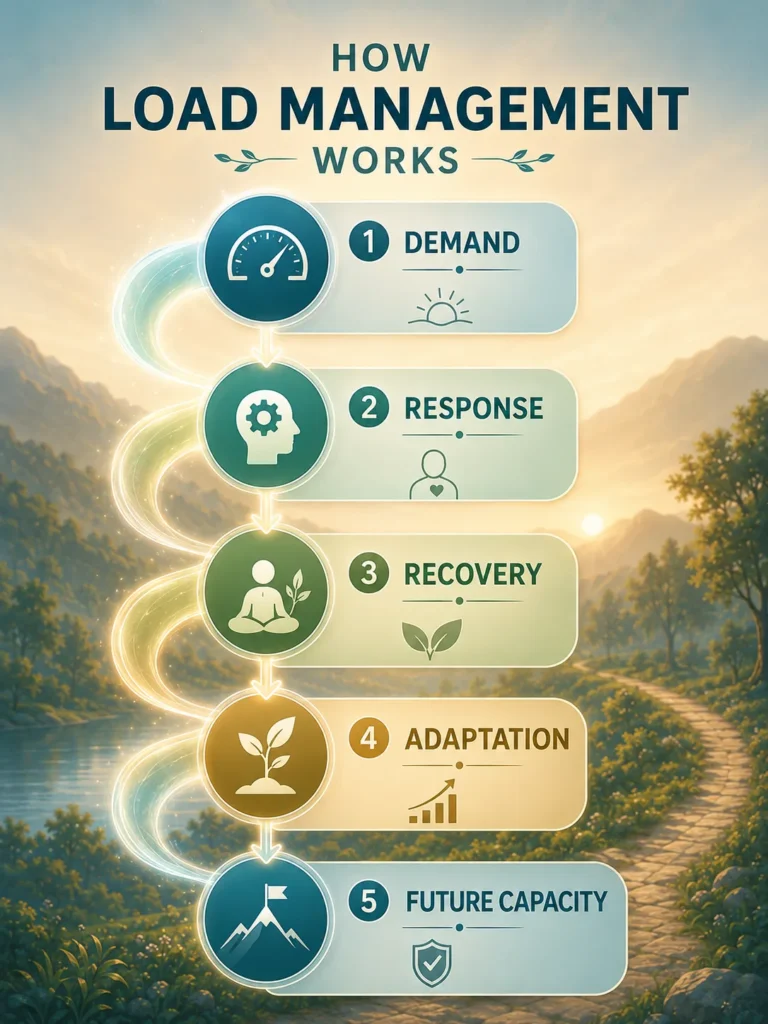
Load Management works like a cycle. First, a demand appears. Then the mind and body respond to that demand. After that, recovery helps restore used resources. Over time, adaptation may help future responses become easier or more efficient.
This process happens every day. Some demands are small. Others are larger. For example, answering messages, learning something new, doing physical tasks, solving problems, and managing emotions can all use energy and attention.
Because daily life includes many types of demands, Load Management helps explain how these demands add up and how people respond to them.
Demand Comes First
Every Load Management cycle begins with demand. A demand is anything that asks for energy, focus, effort, time, or emotional resources.
For example, learning a new skill creates mental demand. A busy schedule creates time demand. Physical activity creates physical demand. A difficult conversation may create emotional or social demand.
Therefore, demand does not come from one source only. It can come from many parts of life at the same time.
The Body and Mind Respond
After a demand appears, the body and mind respond. This response uses available capacity. Capacity may include energy, focus, emotional strength, skills, experience, and recovery resources.
When capacity is enough, the demand may feel manageable. However, when demand is higher than available capacity, the same task may feel harder.
This is why the same activity can feel easy on one day and difficult on another day.
Recovery Restores Resources
After effort, recovery becomes important. Recovery helps restore the resources used during the response.
For example, sleep may restore physical and mental energy. Breaks may support focus. Calm time may help emotional recovery. Supportive relationships may also help restore emotional capacity.
As a result, recovery helps prepare the person for future demands.
Adaptation Changes Future Responses
Adaptation happens when people learn from repeated experiences. Over time, a demand that once felt difficult may feel more familiar.
For example, a new routine may feel stressful at first. However, after practice and experience, it may become easier to manage.
Therefore, adaptation helps explain why people can grow, learn, and respond better over time.
The Simple Load Management Cycle
The cycle is simple:
Demand → Response → Recovery → Adaptation → Future Capacity
This means demand creates load. The person responds with available capacity. Recovery restores resources. Adaptation may improve future responses.
Because this cycle repeats throughout life, Load Management is best understood as an ongoing process. It helps explain balance, resilience, recovery, learning, and everyday function.
Key Layers of Load Management
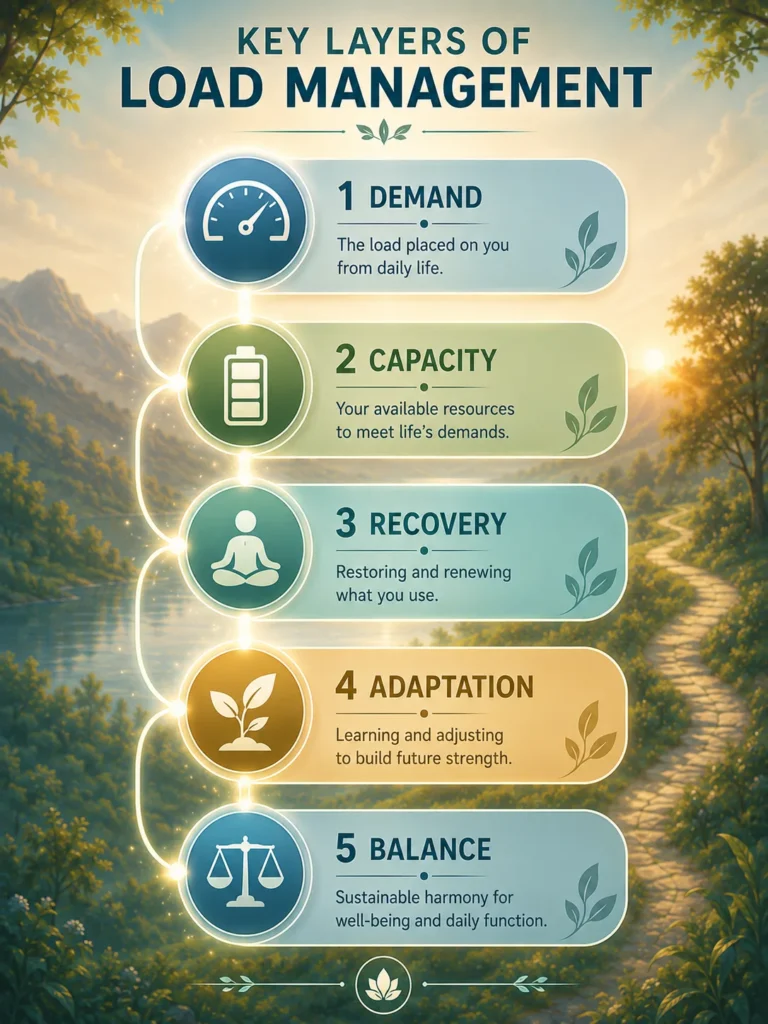
Load Management has several important layers. These layers work together whenever a person faces daily demands. One layer explains what creates load. Another layer explains what a person can handle. Other layers explain recovery, adaptation, and balance.
At first, Load Management may sound simple. However, daily life often includes many types of demands at the same time. A person may have work tasks, family needs, learning goals, emotional stress, social responsibilities, and physical activities in one day. Because of this, load can build from several directions.
The Main Layers
The main layers of Load Management are demand, capacity, recovery, adaptation, and balance. Each layer explains a different part of the process.
Demand explains what life asks from a person. Capacity explains what the person can handle at that time. Recovery explains how used resources are restored. Adaptation explains how learning and experience can improve future responses. Balance explains how these parts work together.
Why These Layers Matter
These layers matter because people do not respond to demand in one simple way. A task may feel easy when capacity is high. However, the same task may feel difficult when energy, focus, or recovery is low.
For example, a busy schedule may feel manageable after good rest. Yet it may feel harder after poor sleep or several stressful days. Therefore, Load Management helps readers understand why the same demand can feel different at different times.
The Bigger Picture
Load Management is not only about reducing activity. It is also not only about handling stress. Instead, it helps explain how people use resources, recover after effort, learn from experience, and adjust over time.
Together, these layers give readers a clearer view of daily function. They show how demand, capacity, recovery, adaptation, and balance shape the way people respond to changing situations throughout life.
Demand Layer of Load Management
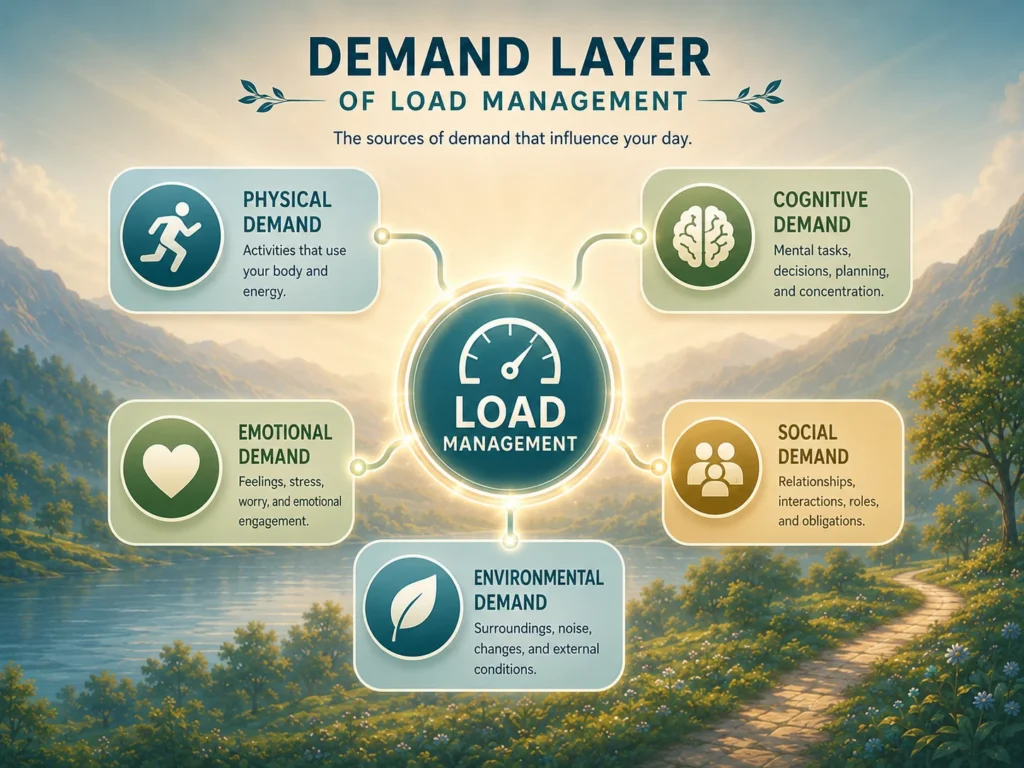
The Demand Layer focuses on what life asks from a person. Every activity, responsibility, challenge, or change creates some form of demand. Some demands are physical. Others are mental, emotional, social, or environmental.
People often think of demand as something negative. However, demand is a normal part of life. Learning new skills, solving problems, building relationships, and achieving goals all require effort. Therefore, demand is not automatically harmful. Instead, it is a natural part of growth and adaptation.
Physical Demands
Physical demands involve activities that require movement, effort, coordination, or energy.
Examples include:
- Walking
- Household tasks
- Exercise
- Carrying objects
- Daily movement
The level of demand can vary depending on the activity, environment, and individual circumstances.
Cognitive Demands
Cognitive demands involve thinking, learning, planning, and decision-making.
For example, studying, problem-solving, organizing tasks, and managing schedules all create cognitive load. Because modern life often requires constant information processing, cognitive demands can become significant.
Emotional Demands
Emotional demands arise from experiences, relationships, responsibilities, and life changes.
For example, uncertainty, conflict, major decisions, and personal challenges may require emotional resources. Therefore, emotional demands often influence overall load.
Social Demands
Social demands involve communication, relationships, teamwork, and social responsibilities.
Conversations, family obligations, work interactions, and community involvement all require varying levels of social effort.
Environmental Demands
Environmental demands come from the surrounding environment.
Examples include:
- Noise
- Distractions
- Busy schedules
- Time pressure
- Unfamiliar situations
Although these demands may seem small, they can contribute to overall load when combined with other factors.
Why the Demand Layer Matters
Understanding demand helps people recognize where load originates. Because demands come from many sources, looking at the whole picture often provides a better understanding than focusing on only one area.
As a result, the Demand Layer forms the starting point of Load Management.
Capacity Layer of Load Management
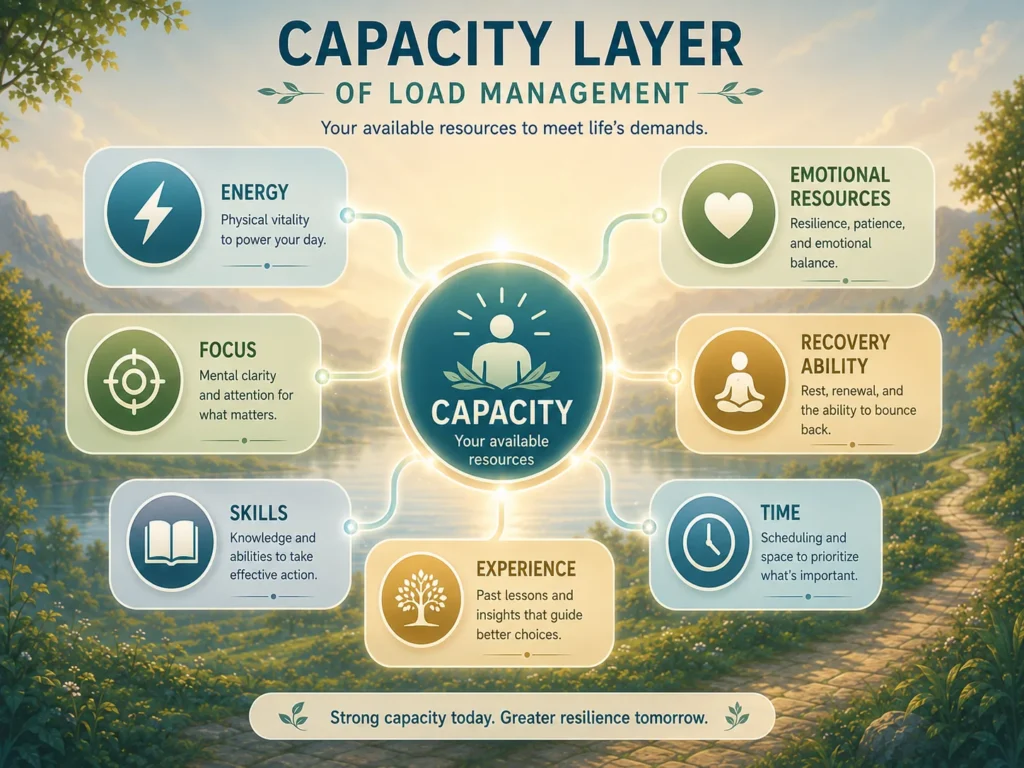
The Capacity Layer explains what a person can currently handle. In Load Management, capacity means the available resources a person has at a specific time. These resources may be physical, mental, emotional, social, and practical.
Capacity is not the same every day. It can rise or fall depending on sleep, recovery, stress, experience, support, environment, learning, and daily routine. Because of this, the same demand may feel easy on one day and harder on another day.
Physical Capacity
Physical capacity includes energy, endurance, strength, movement ability, and general body resources.
For example, after a restful night, a person may feel stronger and more prepared for daily tasks. However, after a long or demanding day, the same person may feel lower in energy. As a result, physical capacity can change from situation to situation.
Cognitive Capacity
Cognitive capacity relates to attention, focus, learning, memory, planning, and decision-making.
Some days, people feel clear and focused. Other days, concentration may feel harder. For example, a person may find it easier to solve problems after good rest. However, after too much information or a busy schedule, thinking may feel slower. Therefore, cognitive capacity is an important part of Load Management.
Emotional Capacity
Emotional capacity means the resources available for handling emotions, relationships, uncertainty, and challenges.
Life experiences, stress levels, recovery, social support, and personal responsibilities can all influence emotional capacity. For example, a difficult conversation may feel manageable when someone feels supported. However, the same conversation may feel harder after several stressful days.
Social Capacity
Social capacity involves the ability to take part in conversations, relationships, teamwork, family needs, and social responsibilities.
Social interaction can be meaningful and helpful. However, it can also require energy, attention, and emotional resources. Because of this, social capacity contributes to overall load. Therefore, Load Management looks at social demands as part of the bigger picture.
Capacity Resources
Capacity is often supported by several practical resources. These resources help people respond to daily demands.
They may include:
• Energy
• Focus
• Skills
• Emotional resources
• Recovery ability
• Time
• Experience
For example, one person may have enough energy but limited time. Another person may have strong skills but reduced focus after a busy day. Likewise, recovery ability and past experience can influence how manageable a demand feels.
Capacity Changes Over Time
One of the most important ideas in Load Management is that capacity is dynamic. This means it changes over time.
Capacity may improve after rest, recovery, learning, practice, or support. However, it may feel lower after poor sleep, repeated stress, heavy responsibilities, or limited recovery.
Because capacity changes, people may respond differently to the same demand at different times. As a result, understanding current capacity can help explain why some tasks feel manageable in one moment and more difficult in another.
Overall, the Capacity Layer helps readers understand that daily function depends not only on demand. It also depends on the resources available to handle that demand.
Recovery Layer of Load Management
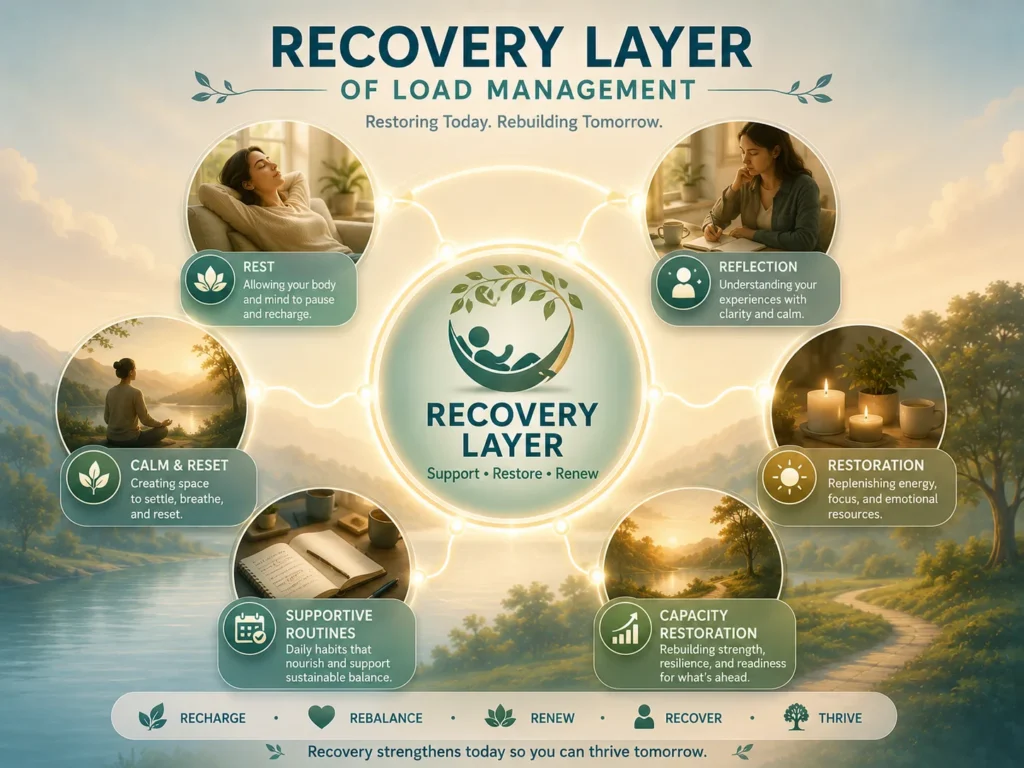
The Recovery Layer focuses on restoring resources after effort, activity, learning, and daily demands. Every demand uses some amount of energy, attention, time, or emotional resources. Therefore, recovery plays an important role in helping people maintain balance over time.
Many people think recovery only means rest. However, recovery can include many different processes. Physical rest, mental breaks, emotional support, relaxation, reflection, and healthy routines may all contribute to recovery. Because different types of demands use different resources, recovery often involves more than one approach.
Recovery does not remove demands from life. Instead, it helps restore the resources needed to respond to future demands. As a result, recovery becomes an essential part of effective Load Management.
Why Recovery Matters
Recovery helps create balance between effort and restoration. Without recovery, demands may continue to use resources faster than they can be restored.
For example, a busy schedule may require time for rest and reflection. A learning challenge may require mental recovery. Likewise, emotionally demanding experiences may require opportunities to process and reset.
Therefore, recovery helps support long-term function, resilience, and adaptation.
Physical Recovery
Physical recovery involves restoring energy and supporting the body’s natural recovery processes.
Examples may include:
- Sleep
- Rest periods
- Gentle movement
- Relaxation
- Balanced daily routines
Physical recovery helps prepare the body for future activities and demands.
Cognitive Recovery
Cognitive recovery focuses on restoring attention, focus, and mental resources.
Throughout the day, people use cognitive resources for learning, planning, problem-solving, and decision-making. Because these activities require mental effort, recovery periods can become important.
Examples may include:
- Taking breaks
- Reducing information overload
- Spending time in calm environments
- Switching between demanding and less demanding tasks
As a result, cognitive recovery may help support concentration and mental flexibility.
Emotional Recovery
Emotional recovery involves restoring emotional resources after challenging or demanding experiences.
Life changes, responsibilities, uncertainty, and relationships can all require emotional energy. Therefore, emotional recovery often becomes an important part of Load Management.
Examples may include:
- Meaningful conversations
- Reflection
- Enjoyable activities
- Relaxation
- Time with supportive people
These experiences may help restore emotional resources over time.
Recovery and Resilience
Recovery and resilience often work together. Recovery helps restore resources. Resilience helps people continue responding to challenges and adapting over time.
Because resilience depends on available resources, recovery often supports long-term adaptability and function.
Recovery as Capacity Restoration
One simple way to understand recovery is to view it as capacity restoration.
Demands use resources. Recovery helps restore resources. Then those restored resources can support future activities, learning experiences, and challenges.
Therefore, recovery acts as an important bridge between effort and future capacity.
Adaptation Layer of Load Management
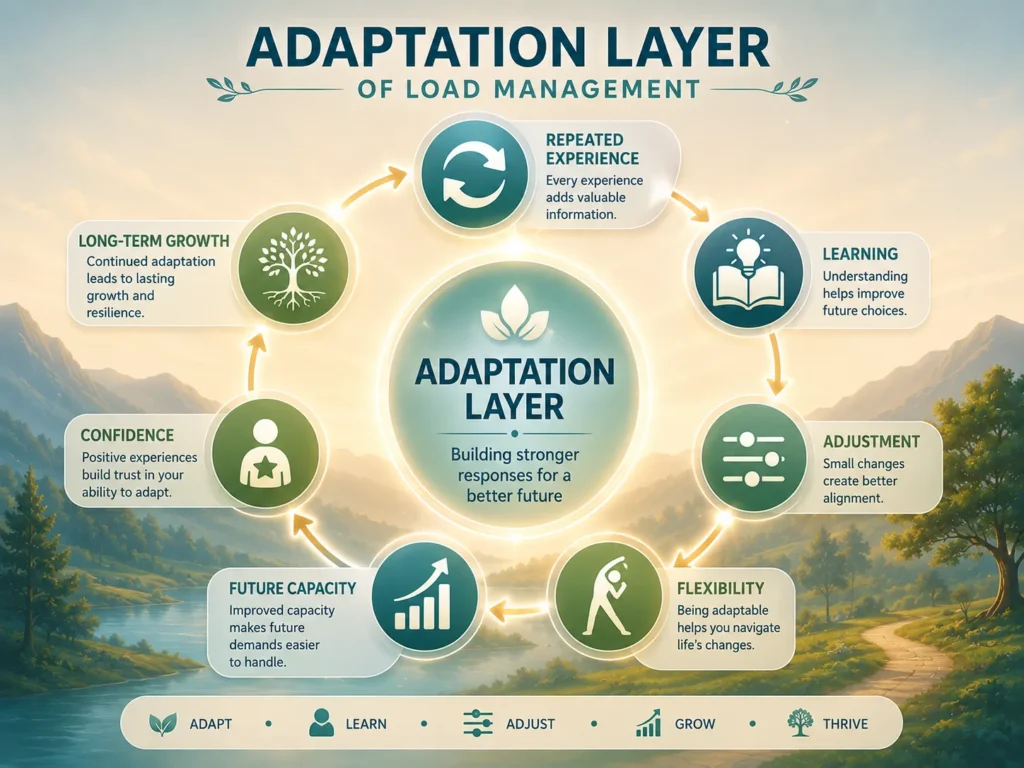
The Adaptation Layer focuses on how people adjust and respond to demands over time. Adaptation develops through experience, learning, feedback, recovery, and repeated exposure to different situations.
Life is constantly changing. New responsibilities appear. Challenges evolve. Skills develop. Environments shift. Because of this, adaptation becomes an important part of everyday function.
Rather than remaining exactly the same, people often learn from experience and gradually improve their ability to respond to future demands.
Adaptation Happens Gradually
Many people expect change to happen quickly. However, adaptation usually develops through small steps over time.
Each experience provides information. Each challenge creates learning opportunities. Each adjustment contributes to future responses.
As a result, adaptation often develops gradually rather than instantly.
Learning Supports Adaptation
Learning is one of the main drivers of adaptation.
For example, a person who repeatedly practices a skill often becomes more familiar with it. Likewise, someone who faces similar challenges over time may develop greater confidence and understanding.
Because learning provides new information, it helps support future adaptation.
Experience Builds Capacity
Experience often influences how people respond to demands.
A situation that once felt difficult may feel easier after repeated exposure. This does not mean the demand disappears. Instead, experience may improve the ability to manage that demand.
Therefore, adaptation often contributes to increased capacity over time.
Adaptation and Flexibility
Adaptation is closely connected to flexibility.
Instead of responding the same way in every situation, people learn how to adjust based on changing circumstances. This flexibility can help support problem-solving, learning, and resilience.
As a result, adaptation helps people respond more effectively to different types of demands.
Adaptation Supports Long-Term Growth
Growth often develops through repeated cycles of demand, recovery, learning, and adjustment.
Over time, these experiences may help people expand skills, improve confidence, increase understanding, and strengthen future responses.
Therefore, adaptation plays an important role in long-term development.
Balance Layer of Load Management
The Balance Layer focuses on the relationship between demand and capacity. While demands are a normal part of life, capacity determines how well those demands can be managed at a given time. Therefore, Load Management is often about finding a workable balance rather than trying to remove all demands.
Balance does not mean life becomes easy or free from challenges. Instead, it means understanding how different demands interact with available resources. Some days capacity may feel high. Other days it may feel lower. Because both demand and capacity can change, balance is often a moving target rather than a permanent state.
Understanding this dynamic relationship helps explain why effective Load Management requires flexibility, adjustment, recovery, and adaptation.
Finding Balance Between Demand and Capacity
Every day involves some level of demand. At the same time, every person has a certain amount of available capacity.
When demands and capacity are reasonably matched, daily activities may feel more manageable. However, when demands remain much higher than available capacity for long periods, adjustment may become necessary.
For example, a busy schedule may require additional recovery time. A new responsibility may require learning and adaptation. Likewise, a major life change may temporarily increase overall load.
Therefore, balance often involves adjusting demands, improving capacity, supporting recovery, or combining all three approaches.
Why Balance Changes Over Time
Balance is not fixed. Instead, it changes as circumstances change.
Sleep quality, learning experiences, stress levels, routines, responsibilities, recovery, and environment can all influence the relationship between demand and capacity. Because these factors constantly change, balance may also shift from day to day.
For example, a task that feels manageable one week may feel more difficult during a particularly busy period. Similarly, a challenge that once felt overwhelming may become easier after experience and adaptation.
As a result, Load Management requires ongoing awareness rather than a one-time solution.
Balance Is Not Perfection
Many people think balance means everything must remain equal at all times. However, real life rarely works that way.
Some periods involve greater effort. Other periods involve more recovery. Some situations require learning and adjustment. Therefore, balance should not be viewed as perfection.
Instead, balance involves responding to changing circumstances while maintaining enough resources to continue functioning, learning, and adapting over time.
Dynamic Balance in Everyday Life
One helpful way to think about balance is as an ongoing process.
Demands change. Capacity changes. Recovery changes. Adaptation changes.
Because all of these factors interact, balance often requires continuous adjustment. Therefore, the Balance Layer helps explain why Load Management is best viewed as a dynamic process rather than a fixed destination.
Real-Life Symptom Language Bridge
Many readers explore Load Management because they notice changes in energy, focus, recovery, resilience, or daily function. Some people feel overwhelmed by responsibilities. Others feel as though they have too much to do and too little capacity to manage everything comfortably.
People often describe these experiences using everyday language rather than technical terms.
For example, someone may say:
- “I feel overloaded.”
- “I have too much on my plate.”
- “I feel drained after busy days.”
- “I need time to recharge.”
- “Everything feels harder than usual.”
- “I don’t seem to recover like I used to.”
- “My schedule feels overwhelming.”
- “I need a better balance.”
These experiences can have many different causes. Therefore, Load Management should never be viewed as the only explanation for symptoms or challenges.
Instead, this topic helps explain one educational framework for understanding how demands, capacity, recovery, and adaptation interact throughout daily life.
Looking Beyond One Cause
Daily function is influenced by many factors. Physical health, emotional experiences, learning demands, relationships, routines, environment, and recovery patterns can all contribute to overall load.
Because multiple factors often interact, it is rarely helpful to focus on only one source of demand. Instead, Load Management encourages a broader view of how different demands combine over time.
Understanding Patterns
One of the most useful aspects of Load Management is pattern recognition.
People may begin noticing when demands increase, when recovery decreases, or when capacity changes. Over time, these observations can help explain why some periods feel easier to manage than others.
As a result, Load Management provides a practical way to think about balance, resilience, recovery, and adaptation in everyday life.
Load Management and Human Systems
Load Management connects closely with Human Systems topics because daily demands influence how people think, feel, learn, adapt, and respond to life experiences. Every person manages multiple forms of load at the same time. Physical demands, emotional experiences, learning challenges, responsibilities, and social interactions all contribute to overall load.
Because these systems constantly interact, understanding Load Management can help readers see the bigger picture. Rather than viewing demands as isolated events, people can begin to understand how different parts of life influence one another.
As a result, Load Management acts as a bridge between recovery, resilience, adaptation, learning, and everyday function.
Emotional Regulation and Load Management
Emotional Regulation and Load Management share a strong connection. Emotions often require energy, attention, and processing resources.
For example, major decisions, uncertainty, conflict, or unexpected changes may increase emotional demands. At the same time, positive experiences, meaningful relationships, and supportive environments may help restore emotional resources.
Because emotional demands contribute to overall load, Emotional Regulation plays an important role in maintaining balance.
Stress & Coping and Load Management
Stress & Coping focuses on how people respond to challenges and demands. Load Management helps explain where many of those demands originate.
For example, a person facing multiple responsibilities may experience increased overall load. Coping strategies may then influence how those demands are managed.
Therefore, Stress & Coping and Load Management often work together to explain adaptation and resilience.
Behavior Change and Load Management
Behavior Change frequently involves adjustments to routines, habits, and daily actions.
However, successful behavior change often depends on available capacity. When demands are already high, introducing additional changes may feel more difficult. On the other hand, balanced load may create more opportunities for learning and adjustment.
As a result, Load Management often influences how behavior change develops over time.
Mental Health & Stress and Load Management
Mental Health & Stress involve many factors that influence daily function and well-being.
Demands related to work, learning, relationships, responsibilities, and life changes can all contribute to overall load. Because of this, understanding Load Management may help readers better understand how different demands interact throughout daily life.
However, Load Management is only one part of a larger picture. Mental well-being is influenced by many connected factors.
Motivation and Load Management
Motivation helps people pursue goals, learn new skills, and continue moving forward during challenges.
At the same time, available capacity can influence motivation. When demands are balanced and recovery is sufficient, motivation may feel easier to maintain. When demands remain very high for long periods, motivation may feel harder to sustain.
Therefore, Motivation and Load Management often influence one another.
Load Management Interactions
Load Management interacts with many other systems throughout daily life. Demands, capacity, recovery, adaptation, learning, resilience, and behavior constantly influence one another.
Because these interactions occur continuously, Load Management should not be viewed as a separate process. Instead, it functions as part of a larger network of human systems.
Load Management and Recovery
Recovery helps restore resources that demands consume.
As demands increase, recovery often becomes more important. Likewise, recovery may influence future capacity and resilience.
Therefore, recovery and Load Management are closely connected.
Load Management and Adaptation
Adaptation helps people respond more effectively to future demands.
As individuals learn from experience, they may develop new skills, greater familiarity, and increased confidence. These changes can influence how future demands are experienced.
Because of this relationship, adaptation remains a central part of Load Management.
Load Management and Resilience
Resilience refers to the ability to continue responding to challenges while adapting over time.
Load Management supports resilience by helping explain how demand, capacity, recovery, and adaptation interact. Therefore, resilience often develops through repeated cycles of learning, recovery, and adjustment.
Load Management and Learning
Learning creates demand. At the same time, learning can also improve future capacity.
For example, developing a new skill may require effort at first. However, that same skill may become easier with experience. As a result, learning often contributes to adaptation and future resilience.
Load Management and Daily Function
Daily function depends on many interacting factors.
Responsibilities, routines, relationships, movement, learning, and recovery all influence overall load. Because of this, Load Management provides a useful framework for understanding how these different elements work together.
Practical Daily-Life Examples
Load Management appears throughout everyday life. Most people use some form of Load Management without realizing it.
For example:
- Organizing a busy schedule
- Balancing work and personal responsibilities
- Learning a new skill
- Preparing for an important event
- Managing household tasks
- Adjusting routines during major life changes
- Planning time for recovery and reflection
- Adapting to new environments
Each of these situations involves balancing demands with available capacity.
Because of this, Load Management can be found in many ordinary daily experiences.

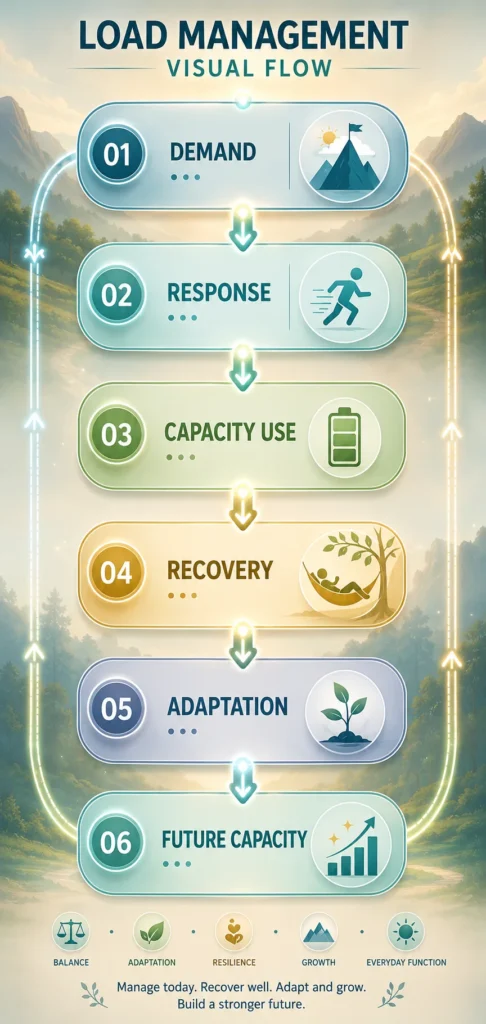
Load Management Visual Flow
Load Management can be understood as a continuous cycle rather than a single event. Demands appear throughout daily life. Then people respond using available resources and capacity. Afterward, recovery helps restore resources, while adaptation may improve future responses.
Because this cycle repeats, Load Management is constantly changing. Some periods involve greater effort. Other periods involve more recovery. Therefore, balance often requires ongoing adjustment rather than a fixed solution.
A simple way to visualize this process is:
Demand → Response → Capacity Use → Recovery → Adaptation → Future Capacity
First, a demand appears. Next, the person responds using available resources. Then recovery helps restore those resources. Over time, adaptation may influence future capacity and future responses.
As a result, Load Management helps explain how learning, recovery, resilience, and adaptation interact throughout everyday life.
Understanding the Flow
The flow is not always perfectly predictable. Different demands create different responses. Likewise, recovery and adaptation vary between individuals and situations.
However, the overall pattern remains similar. Demands require resources. Recovery restores resources. Adaptation influences future capacity.
Because of this cycle, Load Management can be viewed as an ongoing process that supports long-term function and resilience.
Why Load Management Matters
Load Management matters because demands are part of everyday life. Work, learning, relationships, responsibilities, movement, and life changes all require resources. Therefore, understanding how these demands interact with capacity can provide valuable insight into everyday function.
Many people focus only on demands. However, capacity, recovery, and adaptation are equally important. A challenge that feels difficult today may feel easier after recovery, learning, or experience. Because of this, Load Management encourages a broader view of how people respond to life.
Rather than focusing on a single event, Load Management helps explain how patterns develop over time.
Supporting Everyday Function
Daily activities require physical, mental, emotional, and social resources.
When people understand how different demands contribute to overall load, they may find it easier to recognize patterns and make adjustments when necessary.
Therefore, Load Management supports a broader understanding of everyday function.
Supporting Recovery
Recovery helps restore resources after effort and activity.
Because demands continuously use energy and attention, recovery becomes an important part of maintaining balance. As a result, Load Management highlights the relationship between effort and restoration.
Supporting Adaptation
Adaptation develops through learning, experience, and repeated exposure to challenges.
Load Management helps explain how adaptation occurs by showing how demand, capacity, recovery, and learning interact over time.
Therefore, adaptation remains one of the central ideas within Load Management.
Supporting Resilience
Resilience involves continuing to respond to challenges while adapting and recovering over time.
Because resilience depends on available resources, recovery, and adaptation, Load Management provides a useful framework for understanding how resilience develops.
Supporting Long-Term Growth
Growth often occurs through repeated cycles of effort, learning, recovery, and adaptation.
As people gain experience, they may develop new skills, improved understanding, and greater confidence. Therefore, Load Management helps explain how long-term growth can develop through everyday experiences.
Common Misunderstandings About Load Management
Many people misunderstand Load Management. Some believe it only applies to physical activity. Others assume it means avoiding challenges or reducing effort. However, Load Management is much broader than these common assumptions.
Understanding these misconceptions can help readers develop a clearer understanding of the topic.
Misunderstanding: Load Means Physical Effort Only
One of the most common misconceptions is that load only refers to physical activity.
In reality, load can also be cognitive, emotional, social, and environmental. Learning, decision-making, relationships, and daily responsibilities all create different forms of load.
Therefore, Load Management looks at the whole picture rather than physical demands alone.
Misunderstanding: Load Management Means Avoiding Challenges
Some people assume Load Management is about reducing effort or avoiding difficult situations.
However, challenges are often important for learning, growth, and adaptation. The goal is not to remove challenges. Instead, the goal is to balance demands with available capacity and recovery.
Misunderstanding: Capacity Never Changes
Many people think capacity stays the same every day.
In reality, capacity changes constantly. Sleep, recovery, learning, experience, environment, and daily circumstances can all influence available resources.
Because capacity changes, the same demand may feel very different at different times.
Misunderstanding: Recovery Means Doing Nothing
Recovery is often misunderstood as complete inactivity.
However, recovery may include many different activities, such as reflection, enjoyable experiences, social connection, relaxation, learning, and restorative routines.
Therefore, recovery involves restoration rather than simply doing nothing.
Misunderstanding: Balance Means Perfection
Balance does not mean maintaining perfect conditions at all times.
Life naturally includes periods of greater effort and periods of greater recovery. Therefore, balance is best understood as an ongoing process of adjustment.
Looking at the Bigger Picture
Load Management helps explain how demand, capacity, recovery, adaptation, and resilience work together.
Rather than focusing on one factor, it encourages a broader understanding of how people respond to changing situations throughout life.
As a result, Load Management serves as an important educational framework within Recovery Engineering and long-term adaptation.
Related Condition Connections
Some readers explore Load Management because they want to better understand energy, recovery, adaptation, resilience, and daily function. Others may be interested in how different demands influence everyday experiences and overall capacity.
Some people search for these topics because they notice changes in energy, focus, endurance, recovery, resilience, or daily performance. Others may feel overwhelmed by responsibilities, learning demands, life changes, or busy schedules. However, these experiences can have many different causes. Therefore, Load Management should never be viewed as the only explanation.
Instead, this topic provides an educational framework for understanding how demand, capacity, recovery, and adaptation interact over time.
Related educational condition pages include:
- Peripheral Neuropathy
- Diabetic Neuropathy
- Nerve Compression
- Sciatic Nerve Pain
- Post-Injury Nerve Damage
These pages explore different conditions that may influence movement, sensation, function, and daily experiences. As a result, they can help readers develop a broader understanding of nervous system health.
How Load Management Connects With Other Nerve Health Pages
Load Management connects with many topics across the Heal Your Nerves Naturally educational framework. This is because demand, capacity, recovery, and adaptation influence multiple aspects of human function.
For example, Recovery Engineering explores how people learn, adjust, and recover over time. Adaptation Engineering focuses on long-term adjustment. Protocol Design examines structured approaches to learning and recovery. Meanwhile, Healing Sequencing explores how timing and order may influence adaptation.
Together, these topics help explain how people respond to changing demands throughout life.
Connections With Human Systems
Load Management also connects closely with Human Systems topics.
These include:
Each of these topics helps explain how people respond to demands, make adjustments, and develop resilience over time.
Connections With Recovery Engineering
Recovery Engineering topics share particularly strong connections with Load Management.
Examples include:
- Adaptation Engineering
- Feedback Systems
- Protocol Design
- Healing Sequencing
- Integration
- Neuromodulation
These pages explore different aspects of learning, recovery, adaptation, and resilience. Therefore, Load Management serves as one of the foundational concepts within the Recovery Engineering cluster.
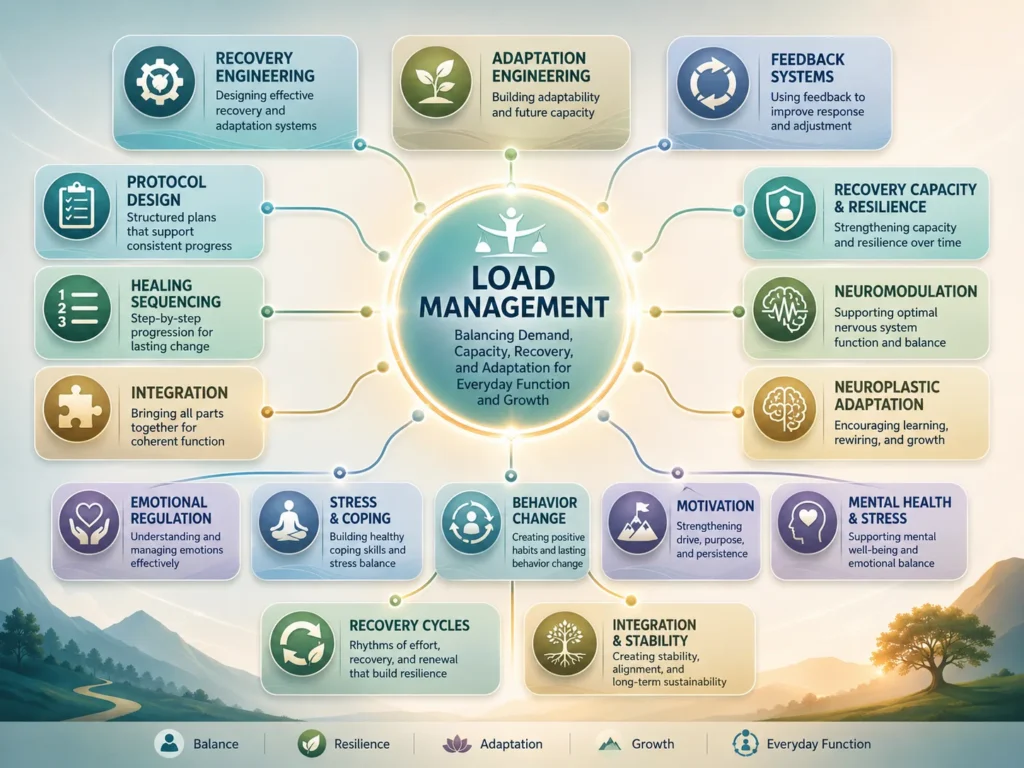
Topic Cluster Placement
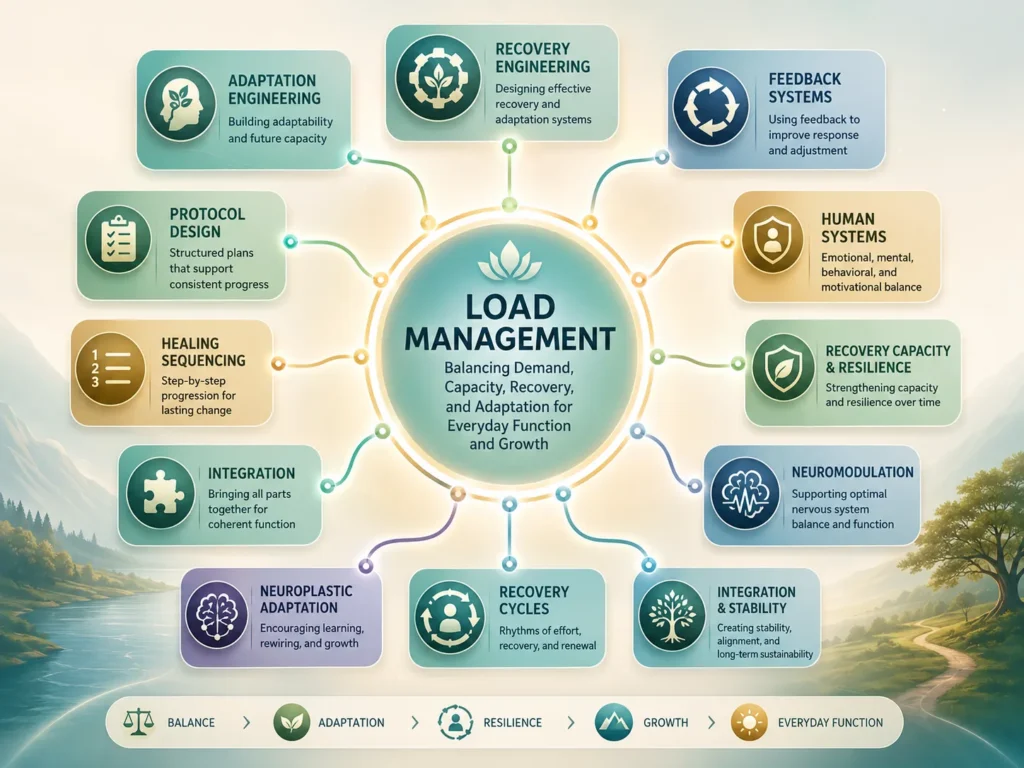
Within the Heal Your Nerves Naturally educational framework, Load Management belongs primarily within the Recovery Engineering cluster.
This topic helps explain how people balance demand, capacity, recovery, resilience, and adaptation. Because of this role, it connects naturally with multiple educational systems across the site.
Primary Cluster
Direct Connections
- Adaptation Engineering
- Feedback Systems
- Protocol Design
- Healing Sequencing
- Integration
- Recovery Capacity and Nervous System Resilience
- Neuromodulation
- Neuroplastic Adaptation
Supporting Connections
- Emotional Regulation
- Stress & Coping
- Behavior Change
- Motivation
- Mental Health & Stress
- Recovery Cycles
- Integration and Stability
As a result, Load Management acts as a central educational topic that helps explain how demand, recovery, adaptation, and resilience interact throughout everyday life.
Load Management FAQ
What is Load Management?
Load Management is the process of balancing demands, available capacity, recovery, and adaptation. It helps explain how people respond to challenges and everyday responsibilities.
What does “load” mean?
Load refers to demands placed on a person. These demands may be physical, mental, emotional, social, or environmental.
Why is Load Management important?
It helps explain how different demands interact with available resources and how recovery and adaptation support long-term function.
Does Load Management only apply to physical activity?
No. Load can come from learning, relationships, work, decision-making, responsibilities, life changes, and many other experiences.
What is capacity?
Capacity refers to the resources available to handle demands. This may include energy, focus, skills, experience, emotional resources, and recovery ability.
Why does recovery matter?
Recovery helps restore resources that demands use. Therefore, recovery plays an important role in maintaining balance over time.
What is adaptation?
Adaptation is the process of adjusting and learning through experience. Over time, adaptation may improve the ability to respond to future demands.
Does balance mean avoiding challenges?
No. Challenges are often important for learning and growth. Load Management focuses on balancing demands with available capacity and recovery.
Can capacity change?
Yes. Capacity can change from day to day based on sleep, recovery, learning, environment, experience, and many other factors.
Is Load Management a medical treatment?
No. Load Management is an educational concept that helps explain demand, capacity, recovery, resilience, and adaptation.
How does Load Management relate to resilience?
Resilience often develops through repeated cycles of demand, recovery, learning, and adaptation. Therefore, Load Management helps explain how resilience can develop over time.
Is this page providing medical advice?
No. This page is for education and awareness only. It does not provide diagnosis, treatment, or medical advice.
Continue Learning
Load Management connects with many educational topics throughout the Heal Your Nerves Naturally framework.
To continue learning, explore:
- Adaptation Engineering
- Feedback Systems
- Protocol Design
- Healing Sequencing
- Integration
- Recovery Capacity and Nervous System Resilience
- Neuromodulation
- Neuroplastic Adaptation
- Emotional Regulation
- Stress & Coping
- Behavior Change
- Motivation
- Mental Health & Stress
- Recovery Cycles
- Integration and Stability
Together, these topics help explain how people learn, recover, adapt, and build resilience through everyday experiences.
Sources / References
The information presented on this page is based on educational concepts that are commonly discussed across health, neuroscience, learning, adaptation, recovery, and human performance fields. To help readers explore these topics in greater depth, it can be useful to review information from trusted health and research organizations.
For example, MedlinePlus provides easy-to-understand health information for the public. Likewise, the National Institutes of Health (NIH) offers educational resources covering a wide range of health and science topics. These organizations help readers learn more about how the body, brain, and nervous system function in everyday life.
In addition, readers who want to explore neuroscience and nervous system topics may find useful information through the National Institute of Neurological Disorders and Stroke (NINDS). This organization provides educational material related to neurological function, research, and nervous system health. Similarly, the National Center for Biotechnology Information (NCBI) gives access to scientific literature, research papers, and educational resources that support deeper learning.
Furthermore, broader health and wellness information can be found through the Centers for Disease Control and Prevention (CDC). The CDC offers educational content related to health, lifestyle, prevention, and public well-being. Meanwhile, organizations such as Cleveland Clinic and Mayo Clinic provide patient-friendly explanations of many health-related topics, making complex information easier to understand.
Together, these resources can help readers build a stronger understanding of adaptation, resilience, recovery, learning, neuroscience, health, and human performance. Therefore, they serve as valuable educational references for anyone interested in exploring the topics discussed throughout this page.
Author / Editorial Trust Note
This page was created as part of the Heal Your Nerves Naturally educational platform. The goal is to explain complex concepts in a simple, practical, and user-friendly way so readers can better understand how demand, capacity, recovery, resilience, and adaptation influence daily life.
Whenever possible, technical language is simplified while maintaining educational accuracy. In addition, real-life examples are used to make important concepts easier to understand.
The purpose of this page is education and awareness. It is designed to help readers explore Load Management as part of a broader understanding of recovery, adaptation, and nervous system health.
Educational Trust Note
Load Management is discussed across many fields, including neuroscience, rehabilitation, psychology, education, sports science, performance science, occupational health, and human factors research.
Although different fields may use different terminology, many share a common interest in understanding how demands interact with available resources over time.
Therefore, this page focuses on broad educational principles rather than specific treatments, therapies, or interventions.
Safety & Education Notice
This page is intended for educational purposes only.
It does not diagnose, treat, cure, or prevent any disease or medical condition. Information presented here should not replace professional medical advice, diagnosis, or treatment.
Symptoms such as severe pain, sudden weakness, major functional changes, significant emotional distress, unusual neurological symptoms, or worsening health concerns should always be evaluated by qualified healthcare professionals.
Load Management should be viewed as an educational framework that helps explain demand, capacity, recovery, resilience, adaptation, and everyday function. It is not a substitute for professional healthcare guidance.