Reading time: 15–20 minutes
Evidence level: Educational, evidence-informed
Last updated: July 2026
Automation: A Complete Guide to Building Consistent Recovery Systems Through Human Systems Engineering
Introduction
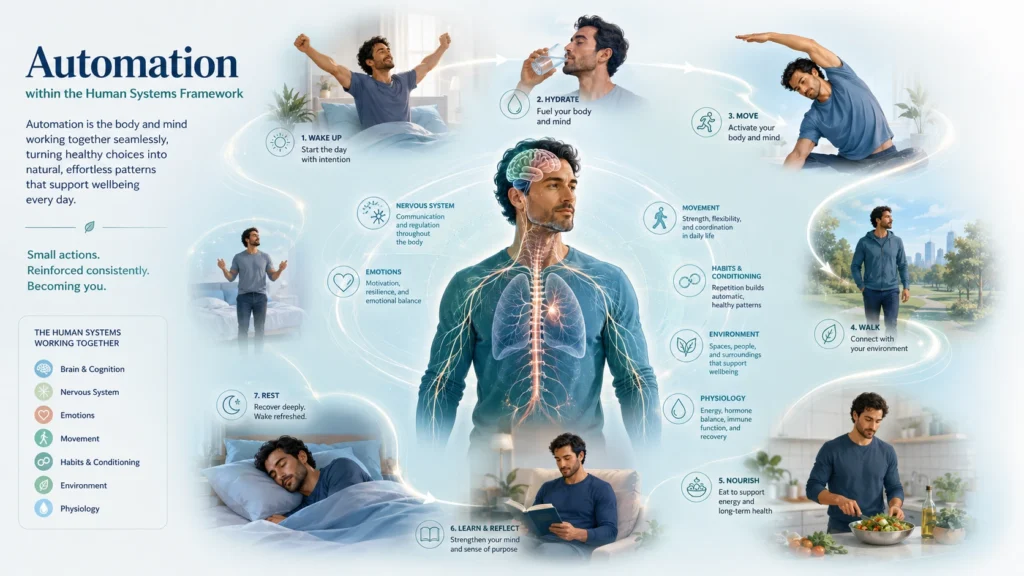
Automation is often associated with robots, artificial intelligence, or computer software. However, within the Human Systems Framework, automation has a much broader meaning. It describes the natural process through which repeated behaviors, consistent decisions, and supportive environments gradually reduce the mental effort required to perform healthy actions. Rather than replacing human judgment, automation helps people perform beneficial behaviors more consistently over time.
Instead of viewing automation as a technological concept alone, this guide explores it as a fundamental human capability that supports learning, adaptation, and long-term recovery.
Automation Is a Natural Human Process
The human body relies on automation every moment of the day. Breathing continues during sleep, posture adjusts while standing, balance responds to changing surfaces, and countless biological systems regulate body functions without conscious effort. Likewise, the brain gradually automates learned skills so that familiar actions require less attention and fewer mental resources.
As a result, people can focus on new challenges instead of consciously controlling every routine activity.
Automation Supports Sustainable Recovery
Recovery often depends on hundreds of small actions repeated over time rather than a single major intervention. Healthy sleep schedules, movement routines, medication reminders, hydration habits, and rehabilitation exercises become easier to maintain when they are supported by reliable systems instead of daily willpower alone.
Consequently, automation helps transform healthy behaviors into consistent patterns that are easier to maintain during both good days and challenging periods.
Automation Works Across Human Systems
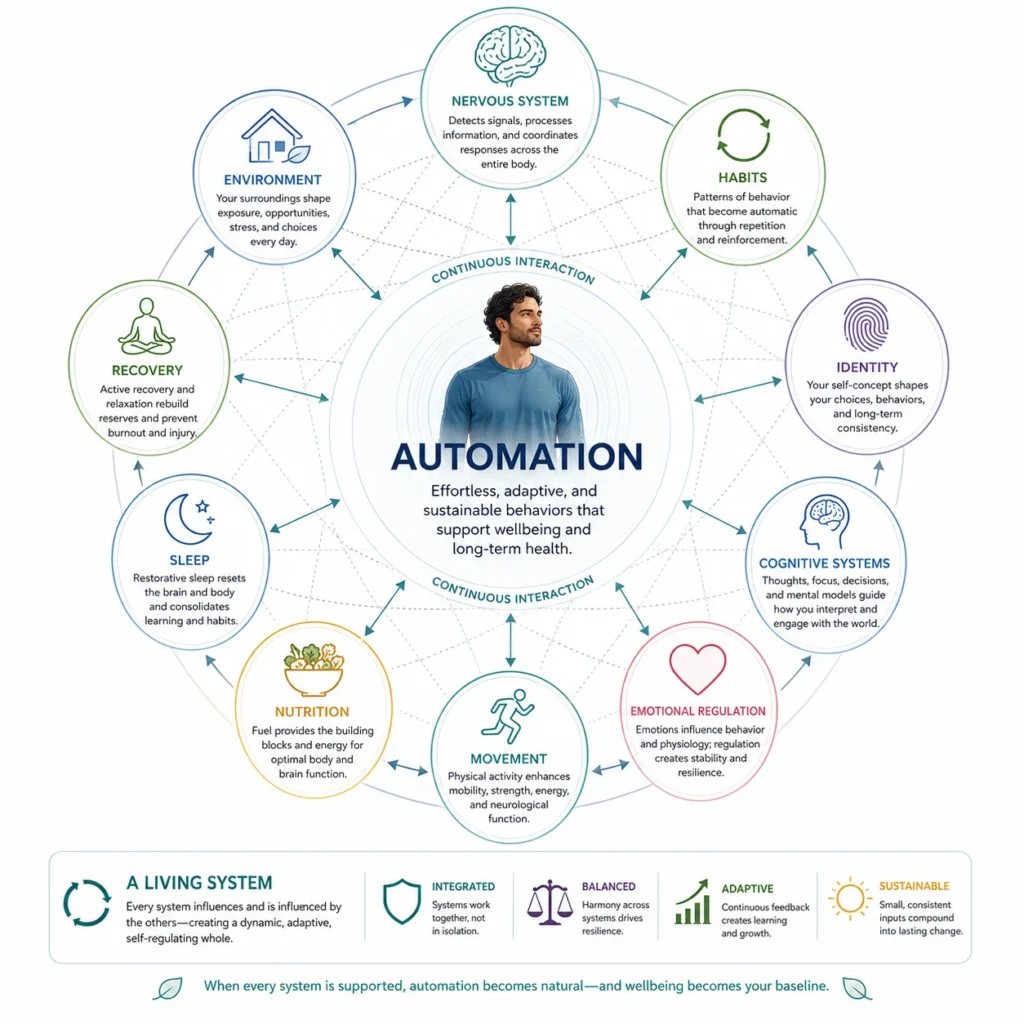
Automation never develops in isolation. Instead, it continuously interacts with multiple Human Systems. The Nervous System supports learning and adaptation, while Cognitive Systems influence attention and decision-making. Likewise, Habits reinforce repeated behaviors, Identity shapes long-term consistency, Emotional Regulation supports resilience, and Recovery Engineering integrates these elements into sustainable systems.
Therefore, automation should be understood as a whole-person concept rather than a single behavioral technique.
Automation Reduces Mental Effort, Not Human Thinking
One of the most common misconceptions is that automation removes the need for conscious thought. In reality, its purpose is to reduce unnecessary thinking rather than eliminate thinking altogether. By minimizing repetitive decisions, automation preserves mental resources for situations that require planning, problem-solving, creativity, and adaptation.
In other words, effective automation supports smarter decision-making instead of replacing it.
An Educational Perspective
Although automation can strengthen healthy behaviors, it is not a medical treatment and should never replace professional healthcare. Recovery depends on many interacting biological, psychological, environmental, and social factors. Accordingly, this guide provides evidence-informed educational information designed to improve understanding rather than diagnose, treat, or prevent any medical condition.
In This Guide, You’ll Learn
- What automation means within the Human Systems Framework.
- Why the brain naturally automates repeated behaviors.
- How automation supports long-term consistency and recovery.
- The biological and psychological science behind automation.
- Different types and levels of human automation.
- How automation interacts with other Human Systems.
- The benefits and limitations of automated behaviors.
- Common misconceptions about automation.
- Practical real-world examples.
- Frequently asked questions.
- Where to continue learning within the Human Systems Library.
Quick Navigation
- What Is Automation?
- Automation in Plain Language
- Why Automation Matters
- How Automation Works
- The Science Behind Automation
- Types of Automation
- Levels of Human Automation
- Automation Across the Human Systems Framework
- Applying Automation in Everyday Life
- Designing Effective Automation Systems
- Final Key Takeaways
- Frequently Asked Questions
- Continue Learning
- References
- About Heal Your Nerves Naturally
- Editorial Principles
- Educational & Medical Disclaimer
- Our Mission
Automation at a Glance
Automation is the process of designing repeatable behaviors and supportive systems that make healthy actions easier to perform consistently over time. Within the Human Systems Framework, automation is viewed as a recovery-supporting principle rather than a technological feature. Instead of relying entirely on motivation or willpower, automation encourages the creation of reliable routines, environmental cues, and structured processes that reduce unnecessary mental effort while promoting long-term consistency.
Furthermore, automation develops gradually through learning, repetition, and adaptation. As behaviors become more familiar, the brain requires fewer cognitive resources to perform them. Consequently, individuals can devote more attention to solving new problems, adapting to change, and participating in meaningful daily activities.
Automation Overview
| Category | Description |
|---|---|
| Definition | The process of making beneficial behaviors and recovery activities more consistent through repeatable systems and learned patterns. |
| Human Systems Category | Recovery Engineering |
| Primary Purpose | Support long-term consistency while reducing unnecessary cognitive effort. |
| Core Principle | Build systems that help healthy behaviors occur reliably instead of depending solely on motivation. |
| How It Develops | Through repetition, learning, environmental design, feedback, and adaptation. |
| Supports | Sustainable recovery, behavioral consistency, and efficient use of mental resources. |
| Does Not Mean | Robots, artificial intelligence, or replacing human judgment. |
| Related Human Systems | Nervous System, Habits, Identity, Cognitive Systems, Emotional Regulation, Personalization, Protocol Design, and Stability. |
Core Principles of Automation
Although automation may appear simple on the surface, it is built upon several interconnected principles that support long-term behavior change.
- Consistency over intensity: Small actions repeated regularly often produce more sustainable outcomes than occasional bursts of effort.
- Systems over willpower: Well-designed systems reduce dependence on memory and moment-to-moment motivation.
- Learning through repetition: Repeated practice allows the nervous system to perform familiar actions with greater efficiency.
- Adaptation through feedback: Effective systems evolve as circumstances, abilities, and goals change over time.
- Flexibility over rigidity: Healthy automation supports adaptation rather than forcing identical routines in every situation.
Why This Concept Matters
Many health-related behaviors succeed or fail not because people lack knowledge, but because maintaining consistent action is challenging. Daily decisions compete with work, family responsibilities, stress, unexpected events, and mental fatigue. Therefore, creating supportive systems can make healthy behaviors easier to repeat even when motivation naturally fluctuates.
Rather than asking people to make perfect choices every day, automation focuses on designing environments and routines that encourage consistent, sustainable action. This systems-oriented perspective forms one of the central ideas within Recovery Engineering and connects closely with many other Human Systems explored throughout this knowledge library.
What Is Automation?
Automation is the gradual process through which repeated actions evolve into reliable patterns that require less conscious effort while maintaining consistent performance. Within the Human Systems Framework, automation is viewed as a natural characteristic of human learning rather than a feature limited to technology. As experience accumulates, the brain becomes increasingly efficient at recognizing familiar situations, selecting appropriate responses, and coordinating behaviors with less deliberate attention.
Instead of treating every action as a new decision, the human nervous system continuously looks for patterns that can be repeated with greater efficiency. Consequently, behaviors that are practiced consistently often become easier to perform because the underlying neural pathways become more organized through learning and adaptation. This natural process supports efficiency without eliminating the ability to think critically or respond to new challenges.
Importantly, automation should not be understood as a fixed destination. Rather, it is an ongoing adaptive process that continues to evolve as people gain new experiences, encounter different environments, and adjust to changing physical or psychological demands. Therefore, effective automation remains flexible enough to support learning while preserving the ability to modify behaviors when circumstances require a different response.
A Human Systems Perspective
Within the Human Systems Framework, automation is not defined by machines, algorithms, or digital tools. Instead, it describes how multiple Human Systems work together to make beneficial behaviors increasingly reliable over time.
For example, the Nervous System strengthens neural pathways through repeated practice, while Cognitive Systems gradually reduce the mental effort required for familiar tasks. At the same time, Habits reinforce recurring behaviors, Identity influences long-term commitment, and Recovery Engineering organizes these elements into practical systems that encourage consistency.
Viewed from this perspective, automation is less about performing actions automatically and more about designing conditions that make healthy behaviors easier to sustain.
Automation Is a Process, Not an Event
Many people imagine automation as something that happens once a behavior becomes effortless. However, scientific evidence suggests that behavioral automation develops gradually through repeated cycles of learning, feedback, and refinement.
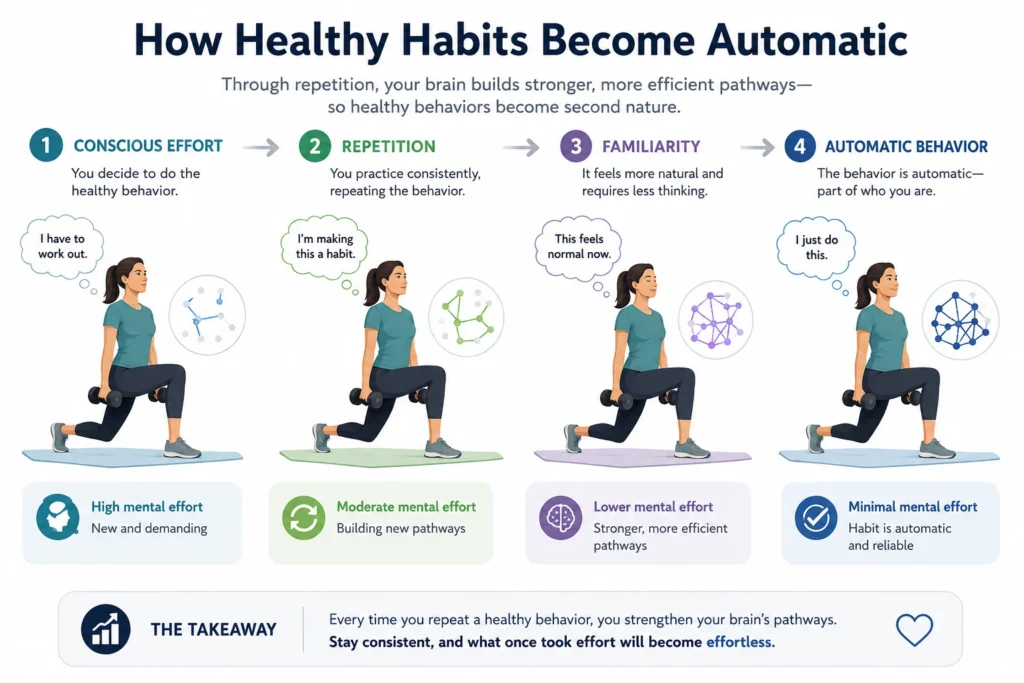
During the early stages of learning, almost every action requires conscious attention. As repetition continues, the brain becomes more efficient at predicting familiar situations and coordinating appropriate responses. Eventually, many routine behaviors require considerably less mental effort than they did initially.
Even then, automation remains adaptable. New information, environmental changes, injuries, illnesses, or lifestyle changes may require previously automated behaviors to be modified. Consequently, healthy automation always allows room for continuous adjustment rather than rigid repetition.
Why the Brain Seeks Automation
The human brain has limited attentional capacity. Every conscious decision requires energy, working memory, and executive control. If every daily action demanded the same level of attention, ordinary life would quickly become mentally exhausting.
Automation helps solve this challenge by allowing frequently repeated behaviors to become increasingly efficient. As familiar activities demand fewer cognitive resources, people gain greater capacity to focus on learning, solving problems, adapting to unexpected situations, and making complex decisions.
From an evolutionary perspective, this efficiency provides a significant advantage. Conserving mental resources enables individuals to respond more effectively to changing environments instead of repeatedly processing the same routine behaviors from the beginning.
Automation Supports Consistency Rather Than Perfection
One of the most valuable characteristics of automation is its ability to improve consistency rather than guarantee flawless performance. Healthy systems acknowledge that people experience fatigue, stress, competing responsibilities, and unexpected disruptions. Accordingly, automation aims to reduce unnecessary barriers that might otherwise interrupt beneficial behaviors.
For instance, a structured morning routine, a scheduled rehabilitation session, or a consistent bedtime routine does not eliminate every obstacle. Nevertheless, these systems can increase the likelihood that important behaviors continue despite normal variations in daily life.
This emphasis on consistency explains why automation has become a foundational principle within Recovery Engineering. Sustainable recovery rarely depends on extraordinary effort performed occasionally. Instead, meaningful progress more often develops through ordinary actions that are repeated reliably over extended periods.
Automation in Plain Language
Technical definitions can make automation sound more complicated than it really is. In everyday life, however, the concept is surprisingly familiar. Most people already rely on automation in countless ways without realizing it. From simple morning routines to well-practiced physical skills, the brain gradually learns how to perform repeated activities more efficiently through experience.
Rather than creating something artificial, automation builds upon the brain’s natural ability to recognize patterns, simplify repeated tasks, and improve efficiency over time.
Learning Makes Actions Feel Easier
Think about learning to ride a bicycle for the first time. Every movement initially requires careful attention. Steering, balancing, pedaling, and braking all compete for mental focus, making the experience feel slow and demanding.
After sufficient practice, the same activity becomes far more natural. Although the movements remain just as complex, they no longer require the same level of conscious control. Instead, the brain coordinates many of these actions automatically, allowing attention to shift toward traffic, road conditions, or other surrounding events.
This gradual reduction in mental effort represents one of the clearest examples of human automation.
Everyday Life Is Full of Automation
Many familiar activities follow the same pattern. Locking the front door, fastening a seat belt, typing on a keyboard, or preparing a familiar meal often happens with very little deliberate planning. These routines develop because repeated experience helps the brain organize information into reliable patterns.
Consequently, people spend less energy on routine decisions while preserving their attention for situations that require learning, creativity, or problem-solving.
Recovery Also Depends on Repeated Patterns
Recovery rarely progresses through one major action. Instead, it usually develops through many small behaviors performed consistently over time. Remembering rehabilitation exercises, maintaining a regular sleep schedule, drinking enough water, or following a structured movement plan may all require considerable attention at first.
As these activities become integrated into daily life, they often demand less conscious effort. Furthermore, supportive routines make healthy behaviors easier to maintain during busy schedules, stressful periods, or temporary setbacks.
The Environment Can Support Healthy Behaviors
Automation is influenced not only by personal behavior but also by the surrounding environment. Small environmental adjustments can reduce unnecessary decisions while encouraging consistency.
For example, placing walking shoes near the entrance may encourage regular physical activity. Likewise, keeping a water bottle within reach can increase hydration throughout the day. Similarly, scheduling rehabilitation exercises at the same time each day reduces the need to repeatedly decide when they should be completed.
In each situation, the environment supports the desired behavior instead of relying entirely on memory or motivation.
Automation Does Not Remove Choice
A common misunderstanding is that automation prevents flexibility. In reality, the opposite is true. Healthy automation reduces unnecessary decisions while preserving the ability to adapt whenever circumstances change.
For instance, an established morning routine may work well on most days. Nevertheless, unexpected travel, illness, or changing responsibilities may require temporary adjustments. Effective systems therefore encourage consistency without becoming unnecessarily rigid.
A Practical Way to Think About Automation
Rather than viewing automation as something controlled by machines, it is more helpful to think of it as a practical method for making beneficial behaviors easier to repeat. The objective is not to eliminate conscious thinking. Instead, the goal is to reduce repetitive mental effort so that attention remains available for decisions that genuinely require planning, learning, and adaptation.
From this perspective, automation becomes an essential building block of sustainable recovery because long-term progress is supported by reliable systems rather than repeated acts of willpower alone.
Why Automation Matters
Many people understand what healthy behaviors are. Nevertheless, knowing what to do does not always lead to consistent action. Daily life introduces competing priorities, unexpected interruptions, emotional stress, and mental fatigue that can make even simple decisions difficult to repeat. Consequently, long-term progress often depends less on knowledge alone and more on the ability to perform beneficial actions consistently.
Automation addresses this challenge by reducing the mental effort required to maintain important routines. Instead of asking people to consciously plan every healthy decision from the beginning each day, it encourages systems that make those decisions easier to repeat under ordinary real-world conditions.
Consistency Is More Powerful Than Occasional Effort
Short bursts of motivation can produce temporary results. However, sustainable progress usually develops through actions that are repeated over weeks, months, and sometimes years.
For example, walking for twenty minutes several times each week generally contributes more to long-term physical health than exercising intensely for only a few days before stopping completely. Likewise, maintaining a regular sleep schedule often provides greater long-term benefits than attempting to compensate for inconsistent sleep with occasional extra rest.
Automation supports this consistency by making repeated behaviors easier to continue, even when daily motivation naturally changes.
Decision Fatigue Affects Everyday Choices
Every decision requires attention and mental energy. Choosing when to exercise, preparing healthy meals, remembering medications, planning rehabilitation activities, or deciding when to rest all compete for limited cognitive resources throughout the day.
As the number of decisions increases, mental fatigue often follows. Consequently, people may postpone, simplify, or completely avoid beneficial behaviors despite fully understanding their importance.
Well-designed routines reduce this burden because fewer decisions need to be made repeatedly. As a result, valuable mental resources remain available for situations that genuinely require careful judgment.
Reliable Systems Reduce Unnecessary Friction
Healthy behaviors often fail because small obstacles interrupt otherwise good intentions. A forgotten reminder, an unpredictable schedule, or a poorly organized environment can easily disrupt daily routines.
Automation helps remove many of these barriers. Scheduling rehabilitation sessions in advance, preparing healthy meals ahead of time, or keeping frequently used equipment easily accessible all reduce unnecessary friction between intention and action.
Although these adjustments may appear minor individually, they can produce meaningful improvements in consistency when repeated over long periods.
Automation Supports Adaptation Rather Than Perfection
Some people believe success requires perfect discipline every day. In reality, human life is rarely predictable. Illness, travel, work responsibilities, family commitments, and unexpected events frequently interrupt established routines.
Effective automation recognizes these realities. Instead of demanding flawless performance, it creates systems that can recover from temporary disruptions and return to healthy patterns more easily. Therefore, resilience becomes an important part of consistency rather than something separate from it.
A Foundation for Long-Term Recovery
Recovery Engineering focuses on creating conditions that support sustainable progress instead of relying on repeated acts of willpower. Automation contributes to this goal by helping beneficial behaviors become increasingly reliable as experience grows.
Rather than expecting people to make perfect decisions every day, this approach emphasizes practical systems that fit naturally into everyday life. Over time, these systems can support healthier routines, improve adherence, and strengthen long-term recovery without increasing unnecessary mental demands.
How Automation Works
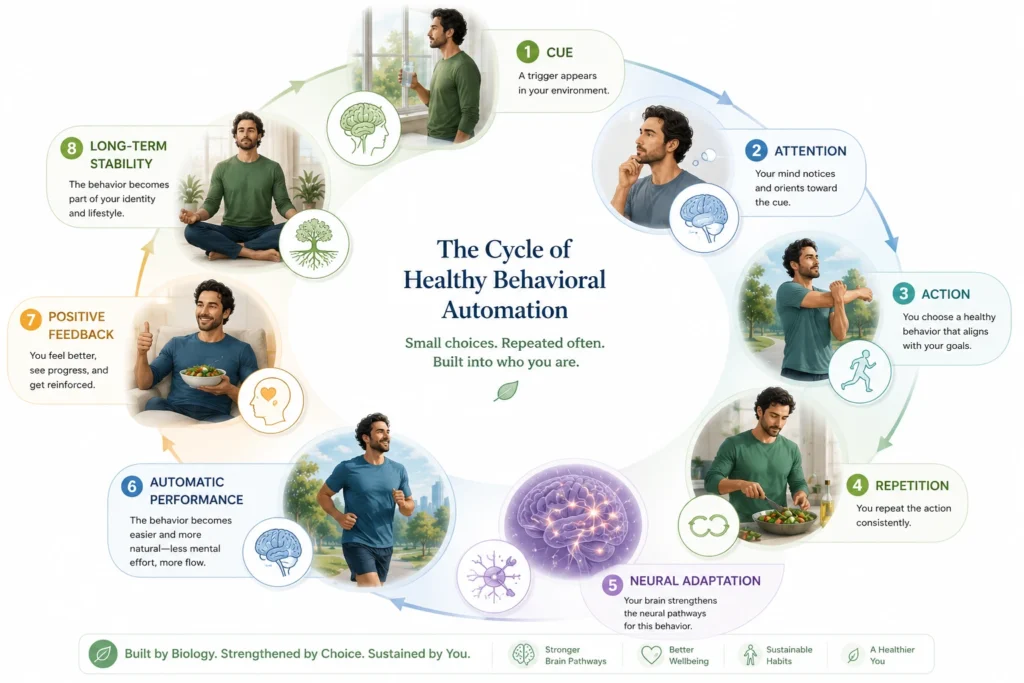
Automation does not appear instantly. Instead, it develops through a gradual process of learning, repetition, feedback, and adaptation. Every repeated action provides the nervous system with new information about what happened, how efficiently it was performed, and whether it should be repeated in the future. Over time, these repeated experiences allow familiar behaviors to become more reliable while requiring less conscious attention.
Although the exact biological mechanisms are complex, the overall process follows a predictable pattern that has been observed across learning, motor control, behavioral science, and cognitive neuroscience. Rather than replacing conscious decision-making, automation gradually shifts routine activities toward greater efficiency while preserving the ability to respond to changing situations.
Every Action Begins With a Trigger
Automation usually starts when something signals that a particular behavior should occur. This signal, often called a trigger or cue, may originate from the environment, the body’s internal state, the time of day, or an established routine.
For example, waking up in the morning may trigger a stretching routine, while sitting at a desk for an extended period may serve as a reminder to stand and move. Likewise, a scheduled reminder can prompt someone to perform rehabilitation exercises or take prescribed medication.
Without a consistent trigger, repeated behaviors are generally more difficult to establish because each action must be initiated through conscious effort alone.
Decisions Lead to Action
Once a trigger is recognized, the brain evaluates available options before selecting an appropriate response. During the early stages of learning, this decision-making process requires considerable attention because each step must be consciously planned.
As experience grows, however, familiar decisions become easier to process. Consequently, fewer cognitive resources are needed to begin the same activity. Importantly, conscious choice is not removed. Instead, repeated experience makes selecting a familiar behavior faster and more efficient.
Repetition Strengthens Reliable Patterns
Each repetition gives the nervous system another opportunity to refine coordination, improve timing, and reduce unnecessary effort. Actions that are performed consistently tend to become more predictable because the brain gradually recognizes recurring patterns.
This refinement does not happen simply because time passes. Rather, improvement depends on meaningful repetition performed under conditions that allow learning and adjustment. Therefore, quality and consistency often contribute more than intensity alone.
Feedback Drives Continuous Improvement
Every completed action generates feedback. Some feedback comes from the body through movement, balance, comfort, or fatigue. Additional feedback may come from the surrounding environment or from achieving a desired outcome.
The brain continuously compares expected results with actual experiences. Whenever differences are detected, future attempts can be adjusted accordingly. As a result, behaviors often become more efficient with repeated practice rather than remaining identical every time they are performed.
This ongoing cycle of observation and adjustment explains why healthy automation remains adaptable instead of becoming rigid.
Efficiency Develops Through Adaptation
As repeated behaviors become increasingly familiar, the amount of conscious attention they require often decreases. This improvement allows mental resources to be redirected toward learning new information, solving unfamiliar problems, or responding to unexpected situations.
Nevertheless, automation never completely replaces awareness. Significant environmental changes, injuries, illness, or new goals may require previously established routines to be modified. Effective systems therefore balance efficiency with flexibility so that healthy behaviors remain appropriate as circumstances evolve.
Automation Is an Ongoing Cycle
Automation should be viewed as a continuous process rather than a final destination. Every successful repetition strengthens useful patterns, while every new experience provides opportunities for further refinement. Consequently, healthy systems remain capable of adapting throughout life instead of becoming permanently fixed.
Within the Human Systems Framework, this continuous cycle explains why sustainable recovery is built on gradual adaptation rather than immediate transformation. Small improvements repeated consistently often create stronger long-term outcomes than isolated efforts performed only occasionally.
The Automation Cycle
Trigger or Cue
        ↓
Conscious Decision
        ↓
Action
        ↓
Repetition
        ↓
Feedback
        ↓
Learning & Adaptation
        ↓
Greater Efficiency
        ↓
More Consistent Behavior
        ↓
Continuous Refinement
The Science Behind Automation
Automation is supported by several well-established scientific principles that explain how people learn, adapt, and perform repeated behaviors more efficiently over time. Although these processes involve multiple body systems, they work together to improve consistency while reducing unnecessary mental effort.
Rather than relying on a single mechanism, automation emerges from the combined influence of learning, prediction, attention, movement, memory, and continuous adaptation. Consequently, it reflects one of the brain’s most efficient strategies for managing everyday activities.
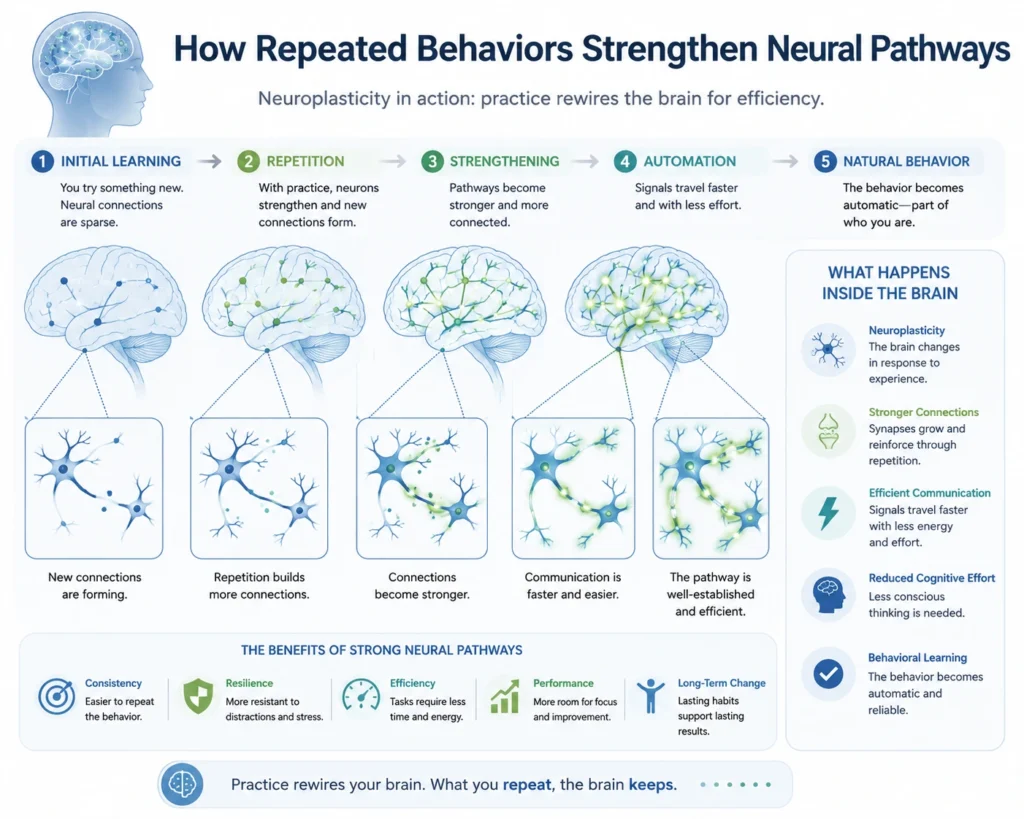
The Brain Is Designed to Improve Efficiency
The human brain processes an enormous amount of information every second. If every familiar action required the same level of conscious attention, even simple daily activities would become mentally exhausting.
To solve this challenge, the brain gradually identifies repeated patterns and develops more efficient ways to perform them. As a result, familiar behaviors demand fewer cognitive resources while remaining accurate and adaptable.
This natural efficiency allows people to reserve attention for unfamiliar situations that require learning, planning, or problem-solving.
Learning Strengthens Reliable Behaviors
Learning does not end after a new skill is acquired. Instead, every successful repetition provides additional information that helps refine future performance.
For example, someone recovering from an injury may initially concentrate on every step during a walking exercise. However, repeated practice gradually improves coordination, confidence, and movement quality. Eventually, walking requires less conscious monitoring because the nervous system has become more familiar with the task.
Therefore, automation should be viewed as an extension of learning rather than a separate process.
Prediction Improves Speed and Accuracy
The brain constantly predicts what is likely to happen next based on previous experience. These predictions help reduce the amount of information that must be processed in real time.
For instance, experienced drivers do not consciously analyze every movement required to operate a vehicle. Instead, many routine actions are anticipated before they occur, allowing attention to focus on changing traffic conditions rather than basic vehicle control.
Likewise, predictable daily routines reduce uncertainty and make healthy behaviors easier to perform consistently.
Attention Can Be Directed More Effectively
Attention is a limited resource. Every unnecessary decision competes with other responsibilities throughout the day. Consequently, reducing repetitive mental demands allows attention to be directed toward activities that genuinely require conscious thought.
Automation contributes to this process by simplifying familiar behaviors without preventing awareness. Instead of eliminating attention, it helps allocate attention where it is most valuable.
This balance between efficiency and awareness supports better performance across many aspects of daily life.
Adaptation Never Stops
One of the most important scientific principles behind automation is continuous adaptation. The brain does not simply memorize behaviors and repeat them forever. Instead, it continuously evaluates new information and adjusts existing patterns whenever necessary.
Changes in health, physical ability, daily schedules, or environmental conditions may all require established routines to evolve. Accordingly, healthy automation remains flexible rather than rigid.
This ongoing adaptability explains why long-term recovery depends on continuous learning instead of fixed routines alone.
Multiple Systems Work Together
Automation cannot be explained by the nervous system alone. Instead, it develops through cooperation between several Human Systems.
Learning depends on the Nervous System, while attention and decision-making involve Cognitive Systems. Likewise, Emotional Regulation influences persistence during setbacks, Habits reinforce repeated behaviors, and Recovery Engineering helps organize these elements into sustainable daily systems.
Viewed together, these interactions demonstrate that automation is a systems-level process rather than the product of any single biological mechanism.
Scientific Principles That Support Automation
| Scientific Principle | Contribution to Automation |
|---|---|
| Learning | Improves performance through repeated experience. |
| Pattern Recognition | Identifies familiar situations and responses more efficiently. |
| Prediction | Anticipates likely outcomes before they occur. |
| Attention Management | Directs mental resources toward important tasks. |
| Adaptation | Adjusts behaviors as circumstances change. |
| Memory | Retains information that supports future performance. |
| Feedback Processing | Refines behaviors based on previous results. |
| Systems Integration | Coordinates multiple Human Systems to support consistency. |
Why the Science Matters
Understanding the science behind automation helps explain why lasting behavior change rarely depends on motivation alone. Instead, consistent progress develops through learning, feedback, adaptation, and efficient use of mental resources. Although these principles operate continuously, they become most effective when healthy behaviors are supported by practical systems that fit naturally into everyday life.
For this reason, Recovery Engineering emphasizes designing environments and routines that work with normal human biology rather than expecting people to overcome it through willpower alone.
Types of Automation
Automation appears in many areas of human life rather than within a single behavior or body system. Although the underlying principle remains the same, different forms of automation serve different purposes. Some improve physical efficiency, whereas others simplify decision-making, strengthen daily routines, or support long-term recovery.
Understanding these different types helps explain why automation is considered a systems-based concept instead of an isolated behavior. Furthermore, recognizing these distinctions makes it easier to design practical strategies that fit individual needs and changing circumstances.
Biological Automation
Some of the most important forms of automation occur naturally within the human body. These biological processes operate continuously without requiring conscious control, allowing essential functions to continue throughout the day and night.
Examples include:
- Breathing regulation
- Heart rate control
- Body temperature regulation
- Hormonal regulation
- Digestive processes
- Balance and postural adjustments
These processes demonstrate that automation is a fundamental characteristic of human biology rather than a concept created by modern technology.
Behavioral Automation
Behavioral automation develops when repeated actions become increasingly consistent through regular practice. Initially, each action may require planning and concentration. However, repetition gradually reduces the amount of conscious effort needed to perform the same behavior.
Examples include:
- Following a regular sleep schedule
- Drinking water throughout the day
- Performing daily stretching exercises
- Completing a morning routine
- Practicing rehabilitation activities
- Preparing healthy meals
Behavioral automation supports consistency by making beneficial actions easier to repeat over time.
Cognitive Automation
Not every automated process involves physical movement. The brain also becomes more efficient at handling familiar mental tasks.
For instance, repeated exposure to similar situations allows people to recognize patterns, interpret information more quickly, and make routine decisions with less mental effort. Consequently, cognitive resources remain available for unfamiliar problems that require deeper analysis.
Examples include:
- Reading familiar words
- Recognizing common patterns
- Performing routine calculations
- Navigating familiar environments
- Organizing repeated daily tasks
Environmental Automation
The surrounding environment can either support or hinder healthy behaviors. Instead of depending entirely on memory or motivation, environmental automation uses physical surroundings to encourage consistent actions.
Simple environmental adjustments often reduce unnecessary barriers while making beneficial behaviors easier to perform.
Examples include:
- Keeping healthy food easily accessible
- Placing exercise equipment where it is visible
- Using calendar reminders
- Organizing medications safely
- Preparing workspaces in advance
- Reducing unnecessary distractions
Rather than forcing behavior, supportive environments gently guide daily decisions toward greater consistency.
Recovery Automation
Within the Human Systems Framework, recovery automation refers to designing repeatable systems that support long-term rehabilitation and healthy living. Unlike biological automation, which occurs naturally, recovery automation is intentionally developed through planning, observation, and continuous refinement.
Examples may include:
- Structured rehabilitation schedules
- Consistent sleep routines
- Progressive movement plans
- Symptom monitoring
- Recovery journals
- Personalized daily checklists
- Regular follow-up routines
These systems reduce unnecessary decision-making while supporting sustainable participation in recovery activities.
Digital Automation as a Supportive Tool
Modern technology can strengthen automation, but technology itself is not automation. Digital tools simply provide additional support for human systems that already exist.
For example, smartphone reminders, wearable devices, digital calendars, health tracking applications, and electronic scheduling systems may improve consistency by providing timely prompts and useful feedback.
Nevertheless, these technologies remain supportive tools rather than replacements for human learning, judgment, or professional healthcare.
Comparing the Different Types of Automation
| Type | Primary Purpose | Typical Examples |
|---|---|---|
| Biological Automation | Maintain essential body functions | Breathing, heart rate, temperature regulation |
| Behavioral Automation | Strengthen repeated healthy actions | Sleep routines, hydration, daily exercise |
| Cognitive Automation | Improve mental efficiency | Pattern recognition, familiar decisions, reading |
| Environmental Automation | Reduce barriers to healthy behaviors | Reminders, organized spaces, visible cues |
| Recovery Automation | Support consistent rehabilitation systems | Recovery schedules, movement plans, monitoring |
| Digital Automation | Assist consistency through technology | Apps, calendars, wearable devices, reminders |
Why These Differences Matter
Although each type serves a different role, they rarely function independently. Instead, they interact continuously throughout everyday life. A recovery routine, for example, may rely on biological adaptation, behavioral repetition, cognitive planning, environmental support, and digital reminders at the same time.
This interconnected perspective reflects one of the central ideas of the Human Systems Framework. Rather than viewing automation as a single skill or technology, it recognizes automation as a coordinated process that helps multiple Human Systems work together more effectively over time.
Levels of Human Automation
Automation develops progressively rather than all at once. Every new behavior begins with conscious effort before becoming increasingly familiar through repetition, experience, and continuous refinement. As learning advances, the brain performs many routine actions more efficiently while preserving the ability to adapt whenever circumstances change.
Importantly, people do not always move through these stages at the same speed. Previous experience, individual abilities, environmental support, and the complexity of the task can all influence how quickly reliable patterns develop. Nevertheless, the overall progression follows a similar direction across many aspects of human behavior.
Level 1: Conscious Learning
Every new behavior starts with deliberate attention. At this stage, people actively think about each step because the task is unfamiliar and requires continuous guidance.
For example, someone beginning a rehabilitation program may need to concentrate on posture, movement, breathing, timing, and technique during every exercise session. Likewise, establishing a regular sleep schedule or following a structured nutrition plan often requires careful planning in the beginning.
Because every decision demands attention, mental effort remains relatively high during this stage.
Level 2: Guided Repetition
As practice continues, familiar patterns begin to emerge. Although conscious attention is still required, repeated experience gradually improves coordination, confidence, and efficiency.
During this stage, fewer mistakes occur because previous experiences help guide future actions. Furthermore, supportive routines and consistent schedules reduce uncertainty while making healthy behaviors easier to repeat.
Learning remains active, but each repetition requires slightly less effort than before.
Level 3: Reliable Performance
With continued practice, many behaviors become increasingly dependable. Individuals spend less time deciding what to do because familiar routines have become more predictable.
For instance, preparing a healthy breakfast, completing a daily stretching routine, or performing prescribed rehabilitation exercises may become part of an established daily rhythm rather than a series of separate decisions.
Consistency becomes more stable because reliable patterns have been successfully reinforced over time.
Level 4: Integrated Automation
At this stage, healthy behaviors fit naturally into everyday life. Rather than competing for attention throughout the day, they become integrated into existing routines and responsibilities.
Importantly, this does not mean the behavior occurs without awareness. Instead, far less mental effort is needed to initiate and maintain the activity because supportive systems already exist.
Environmental cues, organized schedules, and repeated practice often work together to sustain long-term consistency.
Level 5: Adaptive Automation
The highest level of automation is not perfect repetition but continuous adaptability. Effective systems remain dependable while responding appropriately to changing circumstances.
For example, travel, illness, changing work schedules, or new recovery goals may require existing routines to be adjusted. Instead of abandoning healthy behaviors altogether, adaptive automation allows systems to evolve while preserving their underlying purpose.
This flexibility helps maintain long-term consistency even when daily life becomes unpredictable.
Progression of Human Automation
| Level | Primary Characteristic | Mental Effort | Typical Experience |
|---|---|---|---|
| Level 1 | Conscious learning | Very High | Every step requires deliberate attention. |
| Level 2 | Guided repetition | High | Familiarity begins to improve performance. |
| Level 3 | Reliable performance | Moderate | Behaviors become increasingly consistent. |
| Level 4 | Integrated automation | Low | Healthy actions fit naturally into daily routines. |
| Level 5 | Adaptive automation | Efficient and flexible | Systems continue working while adapting to change. |
Progress Is Rarely Linear
People often assume that automation develops in a straight line. However, real life is rarely that predictable. Progress may accelerate during some periods, slow during others, or temporarily move backward following illness, injury, major life changes, or interruptions to established routines.
Fortunately, temporary setbacks do not erase previous learning. In many cases, established behaviors can be rebuilt more quickly because earlier experience provides a strong foundation for future adaptation.
Why These Levels Matter
Understanding these stages helps explain why sustainable behavior change requires patience rather than perfection. Automation develops through gradual refinement, not overnight transformation. Consequently, consistent participation often contributes more to long-term success than occasional periods of intense effort.
Within the Human Systems Framework, these levels illustrate how recovery-supporting behaviors can evolve from conscious practice into dependable systems that remain flexible enough to adapt throughout life.
Automation Across the Human Systems
Automation is most effective when viewed as part of an interconnected human system rather than as an isolated behavioral strategy. Every automated behavior is influenced by multiple biological, psychological, and environmental processes that work together to support consistent daily functioning.
Consequently, understanding these interactions provides a more complete picture of why sustainable recovery depends on coordinated systems instead of individual behaviors alone.
Automation and the Nervous System
The nervous system provides the biological foundation that makes automation possible. Every repeated experience gives the brain and body new opportunities to refine movement, improve coordination, and increase efficiency. Rather than storing isolated actions, the nervous system continuously strengthens useful patterns while adjusting less effective ones through ongoing learning.
As a result, familiar activities generally require less conscious control than newly learned behaviors. This improvement allows routine actions to become more reliable without eliminating the ability to adapt when circumstances change.
Automation and Cognitive Systems
Cognitive Systems influence how people pay attention, process information, remember important tasks, and make decisions. Since attention and working memory are limited, repeatedly making the same decisions can gradually increase mental fatigue.
Automation helps reduce this unnecessary cognitive workload by simplifying familiar decisions. Consequently, more mental resources remain available for planning, learning, problem-solving, and responding to unexpected situations that genuinely require conscious thinking.
Automation and Habits
Although automation and habits are closely related, they are not identical concepts. Habits describe repeated behaviors that become increasingly familiar through experience. Automation, by comparison, focuses on creating reliable systems that make those behaviors easier to perform consistently.
For example, drinking water every morning may become a habit. However, placing a water bottle beside the bed, setting a reminder, and incorporating hydration into an existing morning routine represent automation because these systems actively support the behavior.
Automation and Identity
Long-term consistency is often influenced by how people view themselves. When healthy behaviors become aligned with personal identity, they usually require less internal conflict and fewer daily negotiations.
Automation supports this alignment by allowing positive routines to become part of everyday life. Over time, repeated participation may reinforce a person’s perception of themselves as someone who consistently practices healthy behaviors rather than someone who occasionally attempts them.
Automation and Emotional Regulation
Emotional states frequently influence daily decision-making. Stress, frustration, anxiety, and fatigue can interrupt even well-intentioned plans.
Supportive systems help reduce the impact of these temporary emotional fluctuations. Instead of depending entirely on motivation, established routines provide structure during challenging periods. Therefore, automation can improve consistency even when emotions naturally change from one day to another.
Automation and Recovery Engineering
Recovery Engineering brings together planning, observation, and continuous improvement to support sustainable recovery. Within this framework, automation transforms individual actions into repeatable systems that remain practical in everyday life.
Rather than asking people to remember every task independently, Recovery Engineering emphasizes creating structured processes that reduce unnecessary complexity while encouraging long-term adherence.
Automation and Personalization
No two people share exactly the same lifestyle, abilities, health goals, or daily responsibilities. Accordingly, effective automation should always be adapted to individual circumstances instead of following a universal template.
For example, one person may benefit from digital reminders, while another achieves better consistency through written schedules or environmental cues. Personalization ensures that automated systems remain practical, realistic, and sustainable for each individual.
Automation and Protocol Design
Protocols provide structured guidance, whereas automation improves the consistency with which those protocols are followed.
A rehabilitation protocol may specify what activities should be completed. Automation, however, focuses on designing reminders, routines, schedules, and supportive environments that increase the likelihood those activities are performed consistently over time.
Together, these two concepts strengthen both planning and implementation.
Automation and Stability
Long-term stability depends on maintaining beneficial behaviors despite changing circumstances. Automation contributes to this stability by reducing unnecessary variation in everyday routines while remaining flexible enough to accommodate unavoidable disruptions.
Instead of creating rigid systems, effective automation supports predictable patterns that can be adjusted without abandoning long-term goals.
How Automation Interacts Across the Human Systems
| Human System | How Automation Contributes |
|---|---|
| Nervous System | Improves efficiency through learning and adaptation. |
| Cognitive Systems | Reduces unnecessary mental workload and repetitive decisions. |
| Habits | Supports the consistent repetition of beneficial behaviors. |
| Identity | Reinforces long-term behavioral consistency. |
| Emotional Regulation | Maintains routines during periods of emotional change. |
| Recovery Engineering | Builds reliable systems for sustainable recovery. |
| Personalization | Adapts systems to individual needs and circumstances. |
| Protocol Design | Makes structured plans easier to follow consistently. |
| Stability | Encourages long-term consistency while allowing flexibility. |
Why These Connections Matter
Automation is not a standalone solution. Instead, it functions as a connecting principle that helps multiple Human Systems work together more effectively. While each system contributes something unique, their combined interaction creates conditions that support sustainable behaviors, reduce unnecessary mental effort, and strengthen long-term recovery.
For this reason, automation should be viewed as an integrative framework rather than a single technique. Its greatest value lies in helping different Human Systems operate as a coordinated whole instead of as separate, independent parts.
Practical Applications and Common Challenges
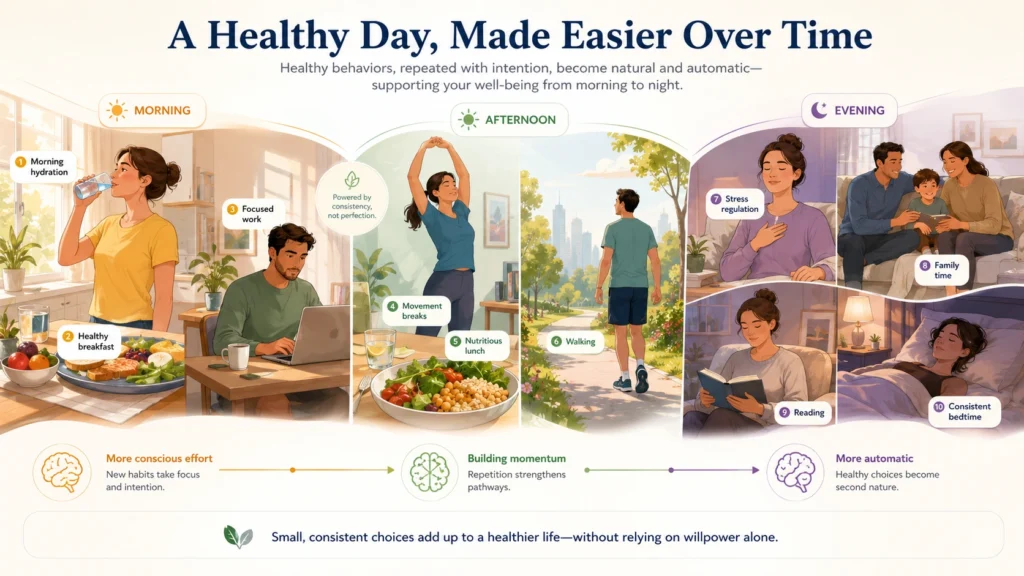
Automation becomes most valuable when it is applied to real life rather than discussed only as a theory. Many people already use automated systems without consciously labeling them as automation. Daily routines, reminders, environmental cues, and structured schedules often work together to make healthy behaviors easier to repeat over time.
At the same time, automation is not always simple. Real life includes interruptions, emotional fluctuations, changing priorities, and unexpected events. Therefore, understanding both the practical uses and the common challenges creates a more realistic foundation for long-term success.
Everyday Applications
Automation can support many areas of daily living when systems are designed to reduce unnecessary decisions while encouraging consistency.
Morning Routines
Many people automate the beginning of their day by linking several activities together.
Examples include:
- Drinking water after waking
- Taking prescribed medications
- Performing gentle stretching
- Reviewing a daily schedule
- Preparing breakfast
Because these actions occur in a predictable sequence, they often require less mental effort than treating each activity as a separate decision.
Movement and Exercise
Physical activity becomes easier to maintain when it is connected to existing routines.
For example:
- Walking after lunch
- Stretching before bed
- Using stairs instead of elevators
- Scheduling exercise at the same time each day
Consistent timing reduces the need to repeatedly decide when movement should occur.
Nutrition
Food-related decisions can create significant cognitive load throughout the day. Simple systems may reduce that burden.
Examples include:
- Planning meals in advance
- Keeping healthy snacks visible
- Preparing ingredients ahead of time
- Using a regular grocery shopping schedule
These strategies do not guarantee perfect nutrition. However, they can make healthier choices easier to repeat consistently.
Sleep and Recovery
Recovery often benefits from predictable routines.
Supportive practices may include:
- Maintaining a regular bedtime
- Reducing bright light exposure before sleep
- Preparing the sleep environment in advance
- Establishing a calming evening routine
When these actions occur regularly, the transition toward sleep may require less deliberate effort.
Rehabilitation and Health Management
People managing chronic conditions frequently use structured systems to support consistency.
Examples include:
- Medication organizers
- Therapy schedules
- Symptom tracking journals
- Follow-up reminders
- Daily checklists
These tools help reduce the likelihood that important tasks are forgotten during busy or stressful periods.
Common Challenges
Despite its benefits, automation does not remove all obstacles. Several challenges commonly interfere with long-term consistency.
Life Changes
Major events can disrupt established routines.
Examples include:
- Travel
- Illness
- Job changes
- Family responsibilities
- Moving to a new environment
When circumstances change, previously effective systems may need adjustment.
Emotional Fluctuations
Stress, anxiety, frustration, and fatigue can reduce participation in healthy routines. Even well-designed systems may become harder to follow during emotionally demanding periods.
Therefore, effective automation should allow flexibility rather than expecting identical performance every day.
Overcomplicated Systems
A common mistake is creating systems that are too detailed or difficult to maintain.
For example:
- Excessive tracking
- Complex schedules
- Too many reminders
- Unrealistic daily goals
When a system requires more energy than it saves, consistency often decreases.
Loss of Awareness
Some people worry that automation encourages mindless behavior. In reality, healthy automation should reduce unnecessary effort while preserving awareness and adaptability.
The goal is not to stop thinking. Instead, the goal is to reserve mental energy for decisions that genuinely require attention.
Common Misconceptions
Several misunderstandings can prevent people from using automation effectively.
Automation Means Technology
Technology can support automation, but automation itself is a human process. A simple paper checklist or a consistent routine can be just as effective as a digital tool.
Automation Eliminates Choice
Healthy systems do not remove choice. They simply make beneficial choices easier to repeat.
Automation Requires Perfect Discipline
In practice, automation is designed to reduce reliance on perfect discipline. Consistency becomes more achievable when supportive systems are already in place.
Automation Works Instantly
Reliable patterns usually develop gradually through repetition, feedback, and adjustment. Most sustainable systems improve over time rather than appearing immediately.
Practical Strategies
The most effective automated systems are usually simple, realistic, and easy to maintain.
Start Small
Beginning with one or two behaviors is often more sustainable than attempting to automate an entire lifestyle at once.
Use Existing Routines
Attaching a new behavior to an established routine can reduce mental effort.
Examples include:
- Stretching after brushing teeth
- Walking after dinner
- Reviewing medications with breakfast
Make Healthy Actions Visible
Environmental cues often influence behavior more than intentions alone.
Helpful examples include:
- Keeping water within reach
- Placing exercise equipment where it can be seen
- Preparing healthy foods in advance
Reduce Friction
The easier a behavior is to start, the more likely it is to be repeated consistently.
For instance, laying out walking shoes the night before removes one small barrier that might otherwise interrupt the routine.
When Automation Needs Adjustment
No system remains perfect forever. Healthy automation should be reviewed whenever:
- Circumstances change significantly.
- A routine becomes difficult to maintain.
- Goals evolve over time.
- Health status changes.
- Stress levels increase for extended periods.
Adjustment is not failure. Instead, it reflects the adaptive nature of effective systems.
Human Systems Perspective
Within the Human Systems Framework, practical automation succeeds because it connects multiple systems rather than relying on a single factor.
- The Nervous System supports learning and adaptation.
- Cognitive Systems reduce decision fatigue.
- Emotional Regulation helps maintain participation during setbacks.
- Habits reinforce repeated behaviors.
- Recovery Engineering organizes these elements into sustainable routines.
When these systems work together, healthy behaviors often become easier to maintain over long periods.
Why Practical Application Matters
Many people understand what they should do for their health. The greater challenge is often doing those things consistently in the middle of ordinary life. Automation helps bridge that gap by turning beneficial actions into repeatable systems that require less unnecessary mental effort.
Consequently, long-term progress becomes less dependent on daily motivation and more dependent on practical systems that can continue functioning under real-world conditions.
Designing Effective Automation Systems
Successful automation does not happen by accident. Instead, it develops through thoughtful system design that supports consistent action while remaining flexible enough to adapt over time. Although every individual has unique needs and circumstances, effective systems often share several common characteristics that make healthy behaviors easier to maintain.
Rather than creating rigid routines that depend on perfect discipline, well-designed automation supports everyday life by reducing unnecessary complexity and encouraging sustainable participation.
Keep Systems Simple
One of the most common mistakes is designing systems that are unnecessarily complicated. Complex routines often require more attention than they save, making them difficult to maintain over time.
Simple systems are generally more sustainable because they reduce mental effort while fitting naturally into existing daily activities.
For example, linking one new recovery behavior to an established routine is often more effective than introducing several unrelated changes at once.
Build Around Existing Routines
Established routines provide stable foundations for introducing new behaviors. Instead of creating entirely new schedules, it is often easier to connect healthy actions to activities that already occur consistently.
For instance, a stretching routine can follow a morning shower, while hydration may become part of breakfast preparation. Likewise, an evening relaxation exercise can naturally follow brushing your teeth before bed.
Building upon familiar routines reduces unnecessary planning and increases the likelihood that beneficial behaviors will continue over time.
Reduce Barriers Before They Appear
Small obstacles frequently interrupt healthy intentions. Fortunately, many of these barriers can be anticipated and reduced through thoughtful preparation.
Examples include:
- Preparing rehabilitation equipment in advance.
- Organizing medications safely.
- Keeping healthy foods easily accessible.
- Scheduling important activities before the day becomes busy.
- Reducing unnecessary distractions during recovery sessions.
Although each adjustment may seem minor, together they create an environment that supports consistency.
Review Systems Regularly
Automation should never remain static. As health status, responsibilities, or personal goals evolve, recovery systems should evolve as well.
Regular reviews help identify routines that continue working effectively and those that require modification. Consequently, automation remains practical instead of becoming outdated or unnecessarily restrictive.
Balance Consistency With Flexibility
Consistency is important, but flexibility is equally valuable. Life rarely follows a perfectly predictable schedule, and unexpected events often require temporary adjustments.
An effective system supports healthy behaviors without creating unnecessary frustration when routines cannot be followed exactly as planned. Therefore, flexibility should be viewed as an essential design feature rather than a weakness.
Characteristics of Effective Automation
| Characteristic | Why It Matters |
|---|---|
| Simple | Easier to understand and maintain consistently. |
| Repeatable | Encourages reliable daily participation. |
| Flexible | Adapts to changing circumstances without losing purpose. |
| Personalized | Fits individual needs, abilities, and recovery goals. |
| Practical | Integrates naturally into everyday life. |
| Reviewable | Allows continuous improvement over time. |
Designing Systems That Last
Long-term success rarely depends on finding the perfect routine. Instead, it comes from building systems that can continue functioning despite everyday challenges. By remaining simple, adaptable, and personally meaningful, automation becomes more than a collection of repeated actions. It becomes a practical framework for supporting healthier decisions, strengthening consistency, and promoting sustainable recovery over time.
Final Key Takeaways
Automation is far more than a technological concept. Within the Human Systems Framework, it represents a practical approach to making healthy behaviors more consistent, sustainable, and easier to maintain through well-designed systems rather than repeated acts of willpower.
The following points summarize the most important ideas explored throughout this guide.
- Automation is a human process, not a technological requirement. Repeated learning, supportive environments, and thoughtful system design help beneficial behaviors become more reliable over time.
- Consistency matters more than occasional intensity. Small actions performed regularly often contribute more to long-term progress than short periods of exceptional effort.
- The brain naturally seeks efficiency. Repetition, learning, and adaptation reduce unnecessary mental effort while preserving the ability to respond to new situations.
- Supportive systems reduce decision fatigue. Structured routines, environmental cues, and practical planning make healthy behaviors easier to repeat under everyday conditions.
- Automation develops gradually. Reliable patterns emerge through continuous practice, feedback, and refinement rather than overnight transformation.
- Effective automation remains flexible. Sustainable systems adapt to changing health needs, personal goals, and life circumstances instead of relying on rigid routines.
- Multiple Human Systems contribute to automation. The Nervous System, Cognitive Systems, Habits, Identity, Emotional Regulation, Recovery Engineering, Personalization, Protocol Design, and Stability all influence how consistent behaviors develop and are maintained.
- Technology can support automation but does not define it. Digital reminders, wearable devices, and health applications are useful tools; however, lasting consistency depends on human learning and well-designed daily systems.
- Automation supports recovery without replacing professional healthcare. Educational systems can strengthen healthy routines, but medical diagnosis, treatment, and rehabilitation should always be guided by qualified healthcare professionals when appropriate.
- Long-term recovery is strengthened by systems that fit everyday life. When healthy behaviors become practical, repeatable, and personally meaningful, maintaining them becomes more achievable despite the normal challenges of daily living.
The Central Message
Automation is not about removing human choice or eliminating conscious effort. Instead, it is about designing environments, routines, and recovery systems that make beneficial behaviors easier to perform consistently. By working with the brain’s natural capacity for learning and adaptation, automation helps transform healthy intentions into sustainable daily practice while supporting long-term well-being.
Frequently Asked Questions
Is automation the same as habit formation?
No. Although the two concepts are closely related, they describe different aspects of human behavior. Habit formation explains how repeated behaviors become familiar over time. Automation, on the other hand, focuses on designing systems, routines, and supportive conditions that make those behaviors easier to perform consistently.
Can automation work without technology?
Yes. Automation existed long before digital technology. A consistent morning routine, a written checklist, or placing important items in a visible location are all examples of automation that require no electronic devices.
Does automation reduce personal responsibility?
No. Automation supports decision-making by reducing unnecessary mental effort, but individuals remain responsible for the choices they make. Well-designed systems assist healthy behaviors rather than replacing personal judgment.
Why do some routines become automatic more quickly than others?
Several factors influence the learning process, including the complexity of the behavior, previous experience, consistency of practice, environmental support, and individual differences. As a result, no single timeline applies to everyone.
Can unhealthy behaviors become automated?
Yes. The brain strengthens repeated patterns regardless of whether they are beneficial or harmful. Therefore, the same learning processes that support healthy routines can also reinforce behaviors that negatively affect health if they are repeated consistently.
Is automation useful only during recovery?
No. Automation supports many aspects of everyday life, including learning, work, physical activity, nutrition, stress management, and personal organization. Recovery Engineering simply applies these principles to support long-term health and rehabilitation.
What happens when an established routine is interrupted?
Temporary interruptions are a normal part of life. Illness, travel, family responsibilities, or unexpected events may disrupt even well-designed systems. Rather than starting over completely, it is usually more effective to adjust the routine and gradually restore consistency when circumstances allow.
Can automation improve long-term adherence?
Research in behavioral science suggests that supportive systems can improve consistency by reducing unnecessary barriers to action. Although no approach guarantees perfect adherence, practical routines often make healthy behaviors easier to maintain over extended periods.
Does automation eliminate the need for motivation?
No. Motivation still plays an important role, particularly when beginning a new behavior or adapting to change. However, effective systems reduce the extent to which everyday participation depends solely on fluctuating motivation.
How often should automated systems be reviewed?
There is no universal schedule. Reviewing systems whenever goals, health status, lifestyle, or daily responsibilities change helps ensure that routines remain practical and relevant.
Can one system work for everyone?
No. Individual needs, physical abilities, recovery goals, and living environments differ considerably. Consequently, successful automation should always be adapted to personal circumstances rather than copied from someone else’s routine.
What is the biggest misconception about automation?
Perhaps the most common misunderstanding is that automation means doing something without thinking. In reality, healthy automation reduces repetitive mental effort while preserving the ability to make thoughtful decisions whenever situations change.
Looking Beyond Automation
Automation is only one part of a much broader Human Systems Framework. Understanding how automation interacts with learning, behavior, cognition, recovery, and environmental design provides a stronger foundation for building sustainable health practices over time.
Continue exploring the Human Systems Library to discover how related systems work together to support long-term adaptation, resilience, and whole-person recovery.
Before You Leave
Common Misconceptions
- Automation is not the same as technology.
- Automation does not eliminate conscious decision-making.
- Automation does not replace motivation.
- Automation does not guarantee perfect consistency.
- Automation is not a substitute for professional healthcare.
Continue Learning
Automation is only one component of a much larger Human Systems Framework. While this guide explains how consistent systems reduce unnecessary mental effort and support sustainable behaviors, long-term health depends on the interaction of many biological, cognitive, emotional, and environmental processes.
For that reason, automation should never be viewed as an isolated strategy. Instead, it works alongside other Human Systems that influence how people learn, adapt, recover, and maintain healthy behaviors throughout different stages of life. Exploring these related topics provides a broader understanding of how whole-person recovery develops through coordinated systems rather than individual actions alone.
Whether you are building healthier daily routines, supporting rehabilitation, improving long-term consistency, or simply expanding your understanding of human behavior, the following cornerstone guides offer valuable next steps for continued learning.
Explore Related Human Systems
Nervous System
Discover how the nervous system supports learning, adaptation, movement, communication, and the biological processes that make automation possible.
Cognitive Systems
Learn how attention, memory, executive function, and decision-making influence everyday behaviors, mental efficiency, and long-term consistency.
Habits
Explore how repeated behaviors develop over time, what strengthens habit formation, and how habits contribute to sustainable lifestyle change.
Identity
Understand how beliefs, self-perception, and personal identity influence long-term behavior and the maintenance of healthy routines.
Emotional Regulation
Learn how emotions affect motivation, resilience, stress management, and the ability to maintain consistent health behaviors during challenging situations.
Protocol Design
Discover how structured recovery plans are developed, organized, and refined to support safe, repeatable, and evidence-informed health practices.
Personalization
Explore why effective recovery systems should be adapted to individual goals, abilities, preferences, and changing life circumstances instead of following a universal approach.
Stability
Understand how consistent daily systems contribute to resilience, reduce unnecessary variability, and support sustainable long-term progress.
Mental Recovery
Learn how psychological recovery supports resilience, cognitive function, emotional well-being, and successful long-term rehabilitation.
Movement Therapy
Explore how purposeful movement supports mobility, functional recovery, physical confidence, and healthy adaptation across different stages of rehabilitation.
Nutrition for Nerve Repair
Discover how nutrition supports nerve health, tissue repair, energy production, and overall recovery while complementing other healthy lifestyle practices.
Circulation & Oxygenation
Understand how healthy circulation and efficient oxygen delivery support tissue function, physical performance, and the body’s natural recovery processes.
Building a Whole-Person Understanding
Each cornerstone guide within the Human Systems Library examines one essential component of human health. Together, these resources create a connected educational framework that explains how individual systems interact to support learning, adaptation, resilience, and long-term well-being.
Rather than viewing recovery through a single perspective, the Human Systems Framework encourages a broader understanding of how multiple systems work together. This whole-person approach helps readers make more informed decisions, build sustainable health practices, and better understand the science that supports lifelong recovery and healthy living.
References
This educational guide is based on current scientific understanding from peer-reviewed research, clinical guidelines, behavioral science, neuroscience, rehabilitation science, and evidence-based public health resources. The references below are provided to support further learning and encourage readers to explore the scientific foundations of automation, human behavior, and long-term recovery.
Although every effort has been made to present accurate and balanced information, scientific knowledge continues to evolve. Readers are encouraged to consult qualified healthcare professionals for individual medical advice and to review original research whenever deeper investigation is appropriate.
Clinical Practice Guidelines
- World Health Organization (WHO). Rehabilitation in Health Systems.
- World Health Organization (WHO). Global Strategy on Integrated People-Centred Health Services.
- National Institute for Health and Care Excellence (NICE). Clinical practice guidelines related to rehabilitation, long-term conditions, and behavior change.
- Centers for Disease Control and Prevention (CDC). Health promotion, chronic disease prevention, and healthy lifestyle guidance.
Neuroscience and Brain Science
- Principles of learning and neural adaptation from contemporary cognitive neuroscience literature.
- Research on motor learning, neural efficiency, and adaptive brain function.
- Evidence describing neuroplasticity, sensorimotor learning, and behavioral adaptation.
Behavioral Science
- Research on behavior change and long-term adherence.
- Evidence relating to decision-making, motivation, and self-regulation.
- Studies examining environmental influences on health behavior.
- Implementation science relating to sustainable behavior change.
Rehabilitation Science
- Research describing functional recovery and rehabilitation planning.
- Evidence on movement rehabilitation and patient participation.
- Studies examining recovery-oriented care and long-term rehabilitation outcomes.
Human Factors and Systems Engineering
- Human Factors and Ergonomics research.
- Systems Engineering principles applied to healthcare.
- Human-centered design for sustainable health systems.
- Workflow design and decision-support research.
Public Health Resources
- World Health Organization (WHO)
- Centers for Disease Control and Prevention (CDC)
- National Institutes of Health (NIH)
- MedlinePlus
- Agency for Healthcare Research and Quality (AHRQ)
Peer-Reviewed Scientific Journals
The scientific concepts discussed throughout this guide are supported by research published in journals covering:
- Neuroscience
- Behavioral Medicine
- Rehabilitation Medicine
- Cognitive Psychology
- Human Factors
- Systems Engineering
- Public Health
- Implementation Science
- Health Psychology
- Physical Medicine and Rehabilitation
Representative journals include:
- Nature Reviews Neuroscience
- Nature Human Behaviour
- The Lancet
- JAMA
- BMJ
- Annual Review of Psychology
- Psychological Science
- Neurorehabilitation and Neural Repair
- Archives of Physical Medicine and Rehabilitation
- Journal of NeuroEngineering and Rehabilitation
- Implementation Science
About Heal Your Nerves Naturally
Heal Your Nerves Naturally is an evidence-informed health education platform dedicated to helping readers understand how interconnected Human Systems influence health, recovery, learning, adaptation, and long-term wellbeing.
Rather than focusing on isolated symptoms or single explanations, our educational content explores how biological, cognitive, emotional, behavioral, and environmental systems work together throughout everyday life. Each cornerstone guide is designed to make complex scientific concepts easier to understand through clear, balanced, and practical communication.
Founded by Hanif Jewel, the Human Systems Library translates research from neuroscience, behavioral science, rehabilitation science, psychology, and health communication into accessible educational resources that support health literacy and informed decision-making.
Editorial Principles
Every cornerstone guide published by Heal Your Nerves Naturally follows the same editorial standards.
Evidence-Informed
Content is developed using peer-reviewed research, clinical practice guidelines, systematic reviews, and established scientific literature whenever appropriate. Educational content is reviewed periodically to reflect current scientific understanding.
Education Before Recommendation
Our purpose is to improve understanding—not to diagnose medical conditions, recommend individualized treatments, or replace professional healthcare. Each guide is written to help readers build knowledge and make more informed discussions with qualified healthcare professionals.
Human Systems Framework
Health is shaped by the interaction of multiple Human Systems rather than a single cause. Accordingly, our educational content explains how biological, cognitive, emotional, behavioral, environmental, and lifestyle factors work together to influence recovery, resilience, and long-term wellbeing.
Continuous Editorial Review
Science continues to evolve. Therefore, educational content may be updated, expanded, or refined over time to improve accuracy, clarity, and educational value.
Educational & Medical Disclaimer
This guide is provided for educational and informational purposes only. It should not be interpreted as medical advice, clinical diagnosis, individualized treatment, rehabilitation instructions, psychological counseling, or emergency healthcare guidance.
Health, recovery, and adaptation vary considerably between individuals. The examples presented throughout this guide are intended to illustrate general scientific principles rather than provide personalized recommendations or guaranteed outcomes.
If you experience persistent or worsening symptoms, sudden neurological changes, severe emotional distress, significant changes in physical or cognitive function, or any medical emergency, seek prompt evaluation from an appropriately qualified healthcare professional.
Readers are encouraged to combine educational information with critical thinking, high-quality scientific evidence, and professional healthcare guidance whenever appropriate.
Our Mission
Our mission is to make evidence-informed health education more understandable, practical, and accessible through the Human Systems Framework. By helping readers understand how learning, recovery, cognition, movement, behavior, emotions, and lifestyle interact, we aim to strengthen health literacy, support informed decision-making, and encourage meaningful conversations with qualified healthcare professionals.